
TL;DR
ChatGPT users still go to Google (95.3%), but only 14.3% of Google users visit ChatGPT—so any “replacement” story doesn’t match behavior.
Users treat search as a fact-checking step because LLMs hallucinate and people don’t fully trust the output.
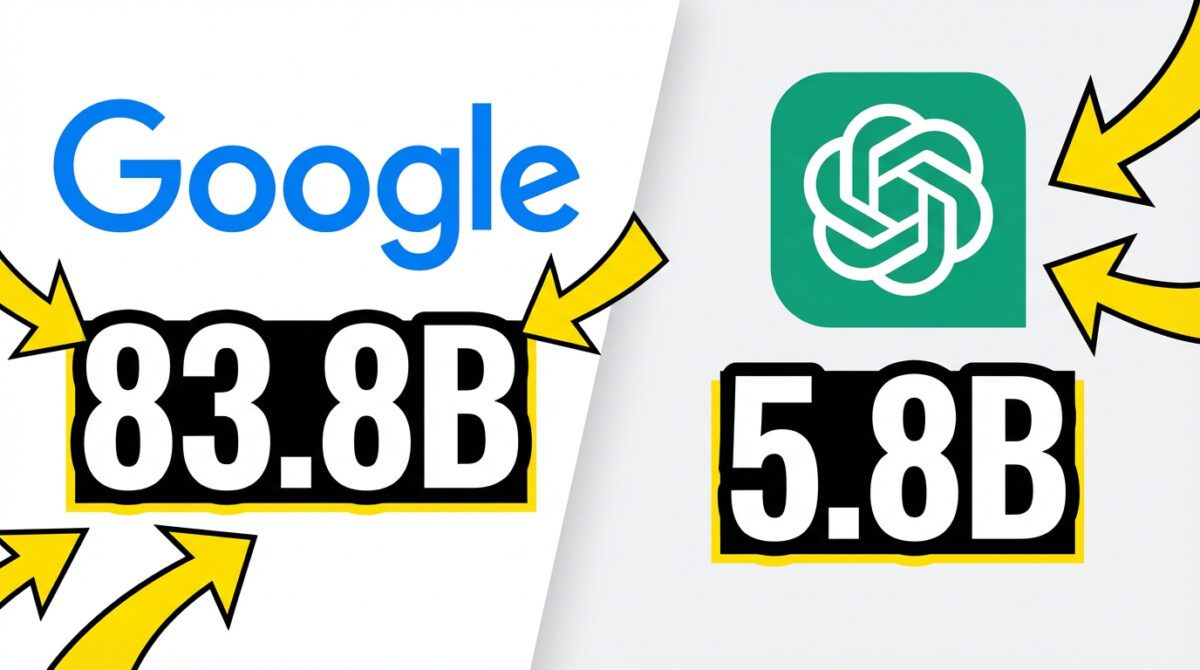
Google’s scale is still an order of magnitude larger, with ~84B visits vs. ChatGPT’s ~5.8B in the cited period.
If leadership is pressuring you to “pivot,” this data supports doubling down on fundamentals (content, technical health, links) rather than reallocating away from SEO.
ChatGPT was supposed to replace Google, wasn’t it? 💡 That’s been the drumbeat for over a year now, and if you work in SEO you’ve probably had a manager or client nervously ask you about it at least a dozen times.
But a recent Search Engine Land analysis of SimilarWeb data shows that nearly all ChatGPT users still rely on Google. Like, 95% of them. 🤷
So is ChatGPT replacing Google search? Not even remotely. And the reason why people keep going back to Google is pretty obvious if you ask me, but it’s also the part that should matter most to you as an SEO professional.
Discover why Google still dominates search!
The Numbers That Kill the Narrative
I want to start here because this is the part that makes the whole “Google is dying” argument fall apart pretty fast.
SEO consultant Brodie Clark shared SimilarWeb data that painted a very clear picture. 95.3% of ChatGPT users also visited Google during that same period.
Flip it around, and only 14.3% of Google users visited ChatGPT. How obvious is this? Think about it. You know AI models hallucinate, and you want to verify that somehow.
So where are you going to go? You’re going to go to another AI model? Probably not.
International SEO expert Aleyda Solis piled on with more data: ChatGPT pulled in about 5.8 billion visits. Impressive, right? Sure, until you see that Google had approximately 84 billion visits.
That’s roughly 14 times more traffic. “AI search is growing, but Google still dominates” is basically the understatement of the year.
| Metric | ChatGPT | |
|---|---|---|
| Monthly Visits | ~5.8 billion | ~84 billion |
| User Overlap (visits other platform) | 95.3% also visit Google | 14.3% also visit ChatGPT |
| Share of Total Search Activity | ~5% | ~95% |
And according to data from Datos and SparkToro, traditional search engines still handle about 95% of all search activity.
So when someone tells you AI search is taking over, you can point to the numbers and let the data do the talking.
Why People Keep Going Back to Google (It’s Obvious If You Think About It)
We know AI models hallucinate, and we want to verify that somehow. So where are you going to go? You’re going to go to another AI model? Probably not.
I mean, I’ve done that. I’ve jumped around from ChatGPT and taken that same content and thrown it onto Claude and said, “hey, fact-check this”. And for small tasks, if both models that are trained differently say the same thing, sometimes that’s good enough.
But for anything with real stakes? You’re going to Google. You’re going to a tab that’s going to be a browser of some source where you can see all the results and evaluate the data for yourself.
That’s really the crux of the whole thing. People know ChatGPT makes stuff up. Not maliciously, but confidently and frequently enough that you can’t just take the output at face value for anything that actually matters.
Google isn’t just surviving the AI era. It’s becoming the verification layer that makes AI usable in the first place.
This is what the “ChatGPT is killing Google” crowd keeps missing. AI doesn’t replace the need for trustworthy search; it actually increases the need.
Every hallucination, every confidently wrong answer, every fabricated citation sends another user right back to Google to cross-check. As Brodie Clark put it, “while the growth continues, users keep returning to Google despite ChatGPT being a search alternative.”
And here’s a detail that people overlook: even when you use ChatGPT’s search functionality, you’re still relying on search. It’s most likely pulling web results from Bing, which is still traditional search infrastructure under the hood.
So even if you’re not doing it directly, you’re doing it indirectly. The whole thing is built on top of traditional search infrastructure. You literally can’t escape it.
ChatGPT vs Google: Complement, Not Competitor
I want to be real clear about something. I don’t think ChatGPT is useless. I use it every day.
It’s great for drafting, brainstorming, summarizing, coding help, and a bunch of other tasks where you need a fast first pass at something.
But that’s exactly the point: it’s a first pass. It’s a complement to search, not a replacement for it.
ChatGPT vs. Google in practice
What ChatGPT Does Well
- Generating first drafts and outlines fast
- Summarizing long documents
- Brainstorming ideas and angles
- Explaining concepts in plain language
- Coding assistance and debugging
What Still Requires Google
- Verifying facts and claims
- Finding primary sources
- Comparing perspectives across sources
- Current information in real time
- Evaluating credibility yourself
Aleyda Solis framed it well when she noted that LLMs are expanding and evolving search as a discovery and marketing channel, not killing it.
And the referral traffic data backs this up. Even though Search Engine Land saw a significant increase in ChatGPT referral traffic, Google organic search still sent roughly 37 times more referral traffic to the same site. Thirty-seven times.
For most publishers, organic search from Google is still responsible for the vast majority of site traffic, while generative AI channels typically deliver a tiny fraction.
That gap isn’t closing anytime soon.
What This Actually Means for SEOs
Alright, so here’s where this data becomes actually useful to you in a practical, “I need to justify my budget” kind of way.
If you’ve been getting pressure from your managers to obsess over showing up in AI models and LLMs, this is your ammunition.
Let’s not obsess so much about GEO and showing up on AI models. Let’s do good SEO, and then the rest will follow. That’s my take, and the data backs it up.
People are still going to Google at a mass rate like they always have been. That’s not changing. The data proves it.
You can use this data to present arguments to your managers that you should be investing more in SEO, not less.

Your move
Use this SimilarWeb data to build your case internally. Traditional SEO still drives the overwhelming majority of organic traffic and revenue, so investing in quality content, technical health, and strong backlinks isn’t the “old” play—it’s the smart play.
Now, I do want to mention one nuance. I don’t believe it’s specifically Google loyalty that’s driving this behavior.
People are just going to the closest search engine they know to fact-check ChatGPT. Google happens to be that search engine for the vast majority of the planet.
But the underlying behavior—needing to verify AI output through traditional search—is the structural shift that matters, and it benefits whoever owns the search experience.
Even ChatGPT’s own search feature relies on Bing’s index for web results, meaning traditional search powers the AI tool that’s supposedly replacing it.
The Real Threat Isn’t AI, It’s Overreacting to AI
If I’m being blunt, the biggest risk to most SEO teams right now isn’t ChatGPT eating their traffic. It’s leadership panicking about ChatGPT eating their traffic and reallocating budget away from what’s actually working.
I’ve seen teams pull resources from proven SEO programs to chase GEO strategies that are, at best, experimental and at worst completely unmeasurable.
Meanwhile, Google is still sending tens of billions of visits a month to the web. That’s where the users are. That’s where the money is.

Don’t abandon what works
If your organic traffic from Google is healthy and growing, shifting budget is a gamble with very little supporting data. The hype cycle is loud, but the user behavior data is clear.
The smart move? Keep doing good SEO. Create content that’s genuinely useful, technically sound, and built around what real people are searching for.
If you do that well, you’ll naturally show up in AI-generated answers too because these models pull from the same high-quality content that ranks well in Google.
The rest follows.
Frequently Asked Questions
Even in cases where ChatGPT referral traffic spiked dramatically, Google still sent roughly 37 times more referral traffic to those same sites. For most websites, AI-driven referrals are a small percentage of total traffic and vary by niche.
No. Traditional search engines still handle roughly 95% of all search activity. Be aware of how AI tools surface content, but gutting your Google SEO program to chase AI visibility is trading proven results for speculation.
Based on the current trajectory, not anytime soon. Google had ~84B visits compared to ChatGPT’s ~5.8B in the measured period, and the gap is enormous. Plus, the need to verify AI output reinforces search usage.
The interesting part is that even heavy AI users still cross-check with Google. The 95.3% overlap suggests fact-checking is broadly consistent, and power users may rely even more on search because they understand AI limitations.
If AI models dramatically reduce hallucinations and build verifiable trust, the dynamic could shift. But we’re not there yet; until AI cites primary sources reliably, users will keep verifying via traditional search.
Final Thoughts
The narrative that ChatGPT is replacing Google search makes for great headlines, but it crumbles under real user behavior data.
People use AI tools and then run to Google to make sure the AI didn’t make something up. That’s not disruption; that’s dependency.
And for SEOs, it’s the strongest argument you can make for doubling down on what works rather than chasing the shiny new thing.
So next time someone in a meeting says “but what about ChatGPT?” pull up this data. Show them the 95.3% overlap. Show them the ~84 billion versus 5.8 billion visits.
Then get back to building the kind of content that ranks well everywhere, because good SEO is still good SEO and the data says that’s not changing anytime soon.
But what are your thoughts? I’d genuinely love to hear if you’re seeing something different in your own analytics.
Sources and References
- Search Engine Land – Nearly All ChatGPT Users Still Rely on Google: Data
- Search Engine Roundtable – All ChatGPT Users Use Google (SimilarWeb Data)
- Digital Information World – Google Stays Default for ChatGPT Users
- DigiTrendz – ChatGPT Users Still Prefer Google: New Data Reveals
- ABP Live – ChatGPT Usage Stats: Google Overlap