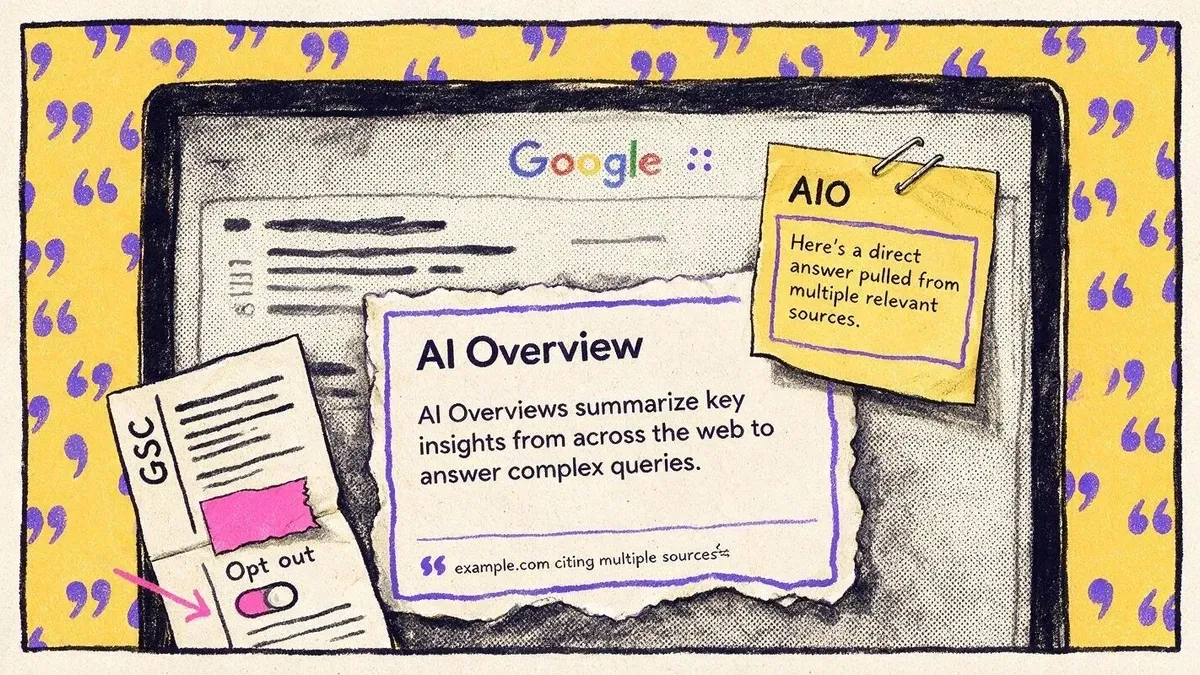
Google AI Overviews are showing up a lot more on desktop, and Ignite Visibility just put a number to it: “nearly 40%” of searches. Here’s their video ⚖️ (YouTube.) Comscore’s June 2026 panel data points in the same direction: 39.4% of U.S. desktop Google searches included an AI Overview (comscore.com). I don’t treat one stat as gospel, but if your money terms are getting summarized you’ve got zero‑click pressure and a different KPI mix for ROI. Plan changes or revenue sags, simple as that.

// My reaction
Uh-oh — revenue impact
Also, Google shipped useful controls. New Search Console reporting for generative features landed June 3, 2026, and a site‑level opt‑out rolled out August 31, 2026. If you own outcomes you should flip these on, measure, then decide if you need opt‑out at a section level for critical journeys. Links here: GSC blog, help doc, Search generative AI control, Google announcement. And the announcement variant with parameters is here too for completeness: developers.google.com.
- AI Overviews showing on a big chunk of desktop means you must measure exposure, earn citations, and protect conversion paths now.
:::callout tip tip
Own a short, quotable answer box on every key page. One sentence up top the model can lift without guessing.
:::
| Intent | Your move |
|---|---|
| Know (informational) | Win the citation: crisp definition, data, and sources |
| Do (how-to) | Stepwise instructions, tools list, safety notes, short video |
| Buy (commercial) | Specs table, comparisons, reviews with use-cases, FAQs |
| Visit (local) | NAP, categories, services, service-area FAQs, photos, reviews |
Should I add FAQ schema to every page?
No. Only where the content genuinely answers discrete questions users ask. Keep answers short and factual.
Are citations enough to win revenue back?
Sometimes. Often you need on‑page tools (calculators, configurators) and stronger mid‑funnel CTAs to convert fewer clicks better.
Do I need to rewrite everything?
Start with your top 50 money pages. Make them extractable, citeable, and conversion‑ready. Then expand.
Own the snippet, then own the next step. If AI answers the question, make your page the obvious click for the job that follows.
- IgniteVisibility: Google AI Overviews Now Appear in Nearly 40% of Desktop Searches | Ignite Friday
- Pew Research: Users are less likely to click when an AI summary appears
- Ahrefs: AI Overviews reduce clicks to #1 by 34.5% on average
- BrightEdge: One year of AI Overviews — industry impact and citation overlap trends
- Google: AI Overviews/AI Mode documentation — no special markup required
- Google Search Central blog: Generative AI performance reports in Search Console (June 3, 2026)
- Support: Control whether your site appears in generative AI features (opt-out toggle)
- Google blog: AI Overviews availability timeline
- TechCrunch: Penske Media sues Google over AI summaries (Sept 2025)
- EU Commission: Proceedings on Google Search data access under the DMA (Jan 2026)
What the “~40%” actually means
- Prevalence is directional, not universal. Query mix, location, and personalization swing this hard. Treat it like weather, not a calendar.
- Impact isn’t uniform. Some AI Overviews cite generously; others answer fully with no clicks. Your play varies by intent (know/do/buy/visit). 📉
- Publishers vs. product vs. local. Publishers fight for citations. Product pages fight for feeds and spec extractions. Local wins on proximity, reviews, and photos. Different jobs, different checklists.
- Bold ledeAI Overviews showing on a big chunk of desktop means you must measure exposure, earn citations, and protect conversion paths now.
Immediate actions if your queries now trigger AI Overviews
Measure exposure and cannibalization
- Build an AIO watchlist. 200–500 queries that matter for revenue and visibility. Track weekly.
- Check which of your terms show AIO, which cite you, and which don’t. Use our AI Visibility Checker to track presence and citation across your priority set: /tools/ai-visibility 🔬
- Model the delta. If queries flip to AIO and CTR falls, shift the KPI for those terms from clicks to views + assisted conversions. Don’t chase ghosts.
Fix answerability and citations
- Make your pages extractable. Clear Q/A, lists, spec tables, and definitions. Short, unambiguous answers first; depth after.
- Add/repair schema. Organization, WebSite, Article/Product/FAQ, Pros/Cons where legit. Validate with our Schema Opportunity Analyzer: /tools/schema-analyzer 🛠️
- Cite primary data. First‑party stats, photos, process shots, and testing notes. AI Overviews prefer sources that look like they did the work.
- Tighten sourcing. Link out to standards, docs, and studies. Make yourself a trustworthy node.
Product and local specifics
- Product: Structured specs (dimensions, materials, compatibility), availability, price, shipping, and warranty in clean markup. Use canonical images and distinct SKUs. Reviews that mention use‑cases beat fluff. 🤖
- Local: NAP consistency, categories, services, photos of real work, and review content that names services and neighborhoods. Build service pages with FAQs and before/after. 📍
:::callout tip tip
Own a short, quotable answer box on every key page. One sentence up top the model can lift without guessing.
:::
What to stop doing
- Walls of text with no extractable summary. If a model can’t find a crisp answer, it will pick someone else.
- Fake FAQs. Only keep questions people actually ask and you can answer precisely.
- Generic buyer guides. No first‑hand details? You’re training the model to skip you.
Reporting and controls you should turn on
- Verify GSC’s generative features reports. Use the new reports to trend impressions and clicks when AIO fires on your terms. Start a baseline, then annotate changes after content or schema updates. See: GSC blog and this variant developers.google.com.
- Decide your AIO control at the right scope. Test site‑wide first, then consider a section‑level opt‑out only where funnels break. Keep receipts in your analytics. Docs: help doc, Search generative AI control, Google announcement.
How I’d triage a site this week
1) Measure and model
- Pull top 300 queries by assisted revenue.
- Flag AIO presence/citation weekly using /tools/ai-visibility.
- Update KPIs for AIO terms to impressions + assisted conversions.
2) Make pages cite‑ready
- Add one‑sentence answer box, then supporting bullets, then detail.
- Add/repair schema with /tools/schema-analyzer and validate.
- Add first‑hand assets: images, short clips, process notes.
3) Patch conversion leaks
- If AIO handles top‑funnel, move CTAs higher: samples, calculators, and trials.
- Add sticky “Talk to a human” or quote boxes where SERP clicks soften.
4) Rebuild weak clusters
- Use topic hubs with canonical definitions, then specific, interlinked spokes.
- Each page = distinct job. No cannibal twins.
| Intent | Your move |
|---|---|
| Know (informational) | Win the citation: crisp definition, data, and sources |
| Do (how-to) | Stepwise instructions, tools list, safety notes, short video |
| Buy (commercial) | Specs table, comparisons, reviews with use-cases, FAQs |
| Visit (local) | NAP, categories, services, service-area FAQs, photos, reviews |
Publisher playbook refresher
If you publish content at scale, your play is “be citeable, be quotable, be consistent.” I wrote about this here: /blog/ai-overviews-paa-publisher-playbook and here: /blog/ai-answers-seo-playbook. Make the answer obvious, the proof visible, and the page clean.
A few realities
- You can’t turn AIO off. You can only earn a mention or shift the user to the next step.
- SERP volatility will rise. AIO modules change more frequently than classic snippets. Expect chops.
- Benchmarks will age fast. Keep re‑measuring. Stop quoting last quarter’s CTR.
Should I add FAQ schema to every page?
No. Only where the content genuinely answers discrete questions users ask. Keep answers short and factual.
Are citations enough to win revenue back?
Sometimes. Often you need on‑page tools (calculators, configurators) and stronger mid‑funnel CTAs to convert fewer clicks better.
Do I need to rewrite everything?
Start with your top 50 money pages. Make them extractable, citeable, and conversion‑ready. Then expand.
Own the snippet, then own the next step. If AI answers the question, make your page the obvious click for the job that follows.
Why this was worth a post
IgniteVisibility puts a number on something we’re all seeing: AI Overviews are common on desktop now. Even if “nearly 40%” shifts by study, the direction is clear. That demands a durable workflow: track exposure, win citations, and rebuild conversion paths to live with zero‑click.
Takeaway: treat AI Overviews as a permanent layer. Measure exposure, make your content extractable and cited, and protect revenue with on‑page tools and clearer CTAs. That’s SEO/GEO/AI practice in 2026, not chasing positions, designing content for models and humans at the same time.
