Google paying publishers for AI? Your 72 hour triage and readiness playbook
Barry Schwartz dropped a quick hit on reports that Google is paying select publishers for AI contribution, fresh ranking turbulence, and the ad tech case. Worth talking about because money, attribution, and exposure might shift inside AI answers while your classic SERP traffic wobbles. 🔎

// My reaction
Surprised Barry reacts
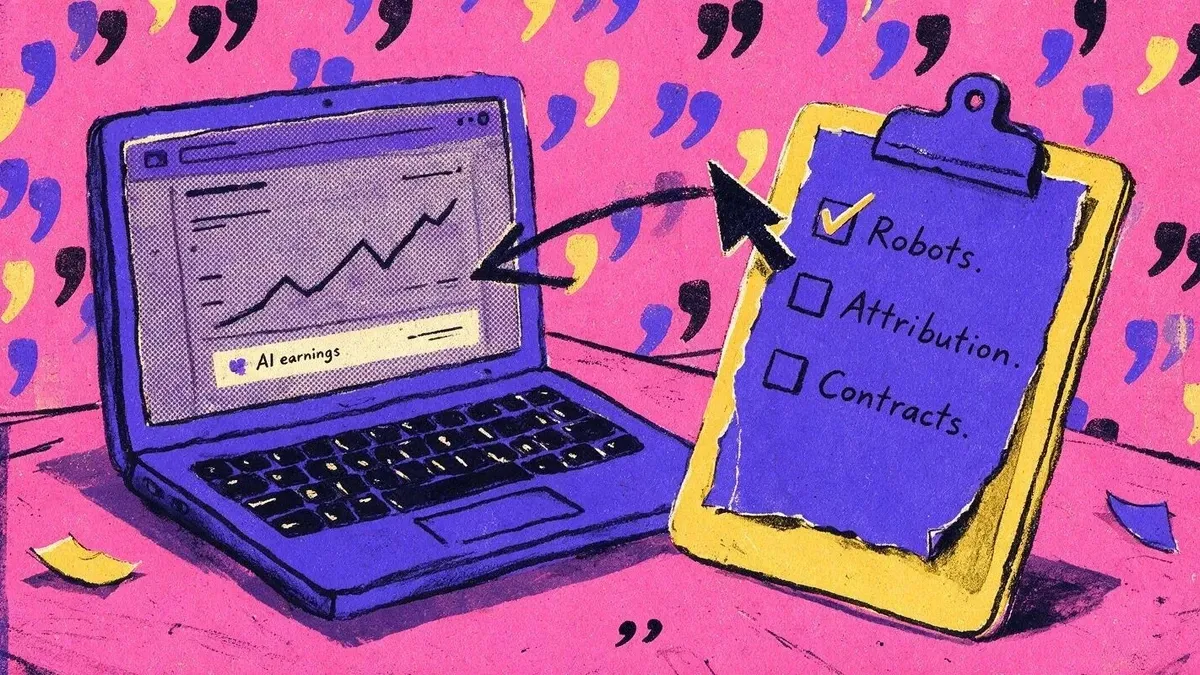
I care because if payouts and attribution move into AI surfaces, you need robots controls, attribution schema, and contract hygiene ready before any invite shows up. And if you’re feeling volatility, you separate AI displacement from true rank loss first or you’ll chase your tail for a week.
Source video: Barry Schwartz — Sep 18: Google paying publishers for AI contribution, wild ranking volatility and ad tech monopoly. YouTube. (seroundtable.com)
- AI licensing chatter is real enough to plan forDon’t forecast revenue; get robots controls, attribution, and contracts ready now.
- Volatility demands triage, not rewritesQuantify AI displacement vs. ranking loss before touching templates.
- Structure extractable answersAnswer‑first, citeable, entity‑clean content feeds both AI answers and classic SERPs.
- Plan for AI licensing without guessing payoutsGet training controls, attribution, and contracts in order so you’re easy to cite and safe to license.
- Triage volatility before editsConfirm AI displacement vs rank loss, then isolate by intent and template.
- Ship extractable answersAnswer-first, citeable structure wins in AI and classic SERPs.
What Barry reported and why it matters now
Here’s what’s verifiable:
- Barry’s 9/18 recap references chatter that Google is paying invited publishers for AI contribution; he also links to coverage. Treat this as reporting, not a public policy. SERoundtable recap. (seroundtable.com)
- Digiday reports an “AI contribution pilot” that pays invited publishers when their content “significantly” contributes to AI Overviews/AI Mode/Gemini, with an “AI earnings” panel for invitees in Search Console. That’s a pilot, not a program you can apply to. Digiday and a neutral echo from Insider/analyst roundups. (digiday.com)
- Ranking turbulence: community trackers flagged drops ~Sep 4, reversals ~Sep 13, and a fresh spike Sep 15, unconfirmed by Google but useful for annotations. SERoundtable Sep 14 and Sep 15. (seroundtable.com)
- DOJ ad tech remedies: the court ordered behavioral fixes, not a breakup, with interoperability, equal terms bidding into rival ad servers, bid data sharing with publishers, and a six year monitor. DOJ press release and coverage: Search Engine Land, TechRadar Pro. (justice.gov)
Why now? Because AI answers in Search are already siphoning attention. If you’re not separating AI displacement from classic rank loss, you’re guessing. If you’re not ready on robots and attribution, you’re negotiating from your heels. For background on the measurement workflow and formatting patterns, see Google AI Reports: Measure Displacement Before You Change Pages (/blog/measure-ai-displacement-reviews-links) and Build Content for AI Search: Answer‑First, Citeable, and Extractable (/blog/build-content-ai-search).

// My reaction
Frustrated triage
Measure, segment, then act — in that order.
The measurement first 72 hour plan (Don’t change pages yet)
Start with data, not edits.
- Use Search Console’s Generative AI performance report to quantify AI feature impressions, then pair that with your standard Performance report and analytics to understand clicks. Rollout completed Aug 31, 2026. GSC help doc. (support.google.com)
- Cross check a sample of affected SERPs. If AI Overviews or AI Mode is present, flag the query. A preregistered field experiment (Aug 18, 2026) found that removing AI features increased publisher clicks, forcing an AI Mode only experience reduced clicks and trust. arXiv 2608.18352. (arxiv.org)
- Expect activation to skew by intent. A May 2026 study measured AIO activation at 13.7% overall and 64.7% on question queries, with 11.0% of atomic claims unsupported by the cited pages. arXiv 2605.14021. (arxiv.org)
- Define two buckets:
- Stable rank, falling clicks = likely AI displacement.
- Rank down and clicks down = classic ranking loss. Different workstream.
- Need quick monitoring while you set this up? Use a rank and SERP features snapshot to confirm features and intent shifts while your GSC views get segmented. I’d spin up a short term tool run and then shut it down. 🧪
Do this before you change pages. Also, if you need a fast way to spot AI features at scale, use my AI Visibility Checker at /tools/ai-visibility alongside GSC. 📉
| Signal or page type | What to check first |
|---|---|
| Stable rank, falling clicks | AI displacement: check Generative AI performance report; eyeball SERP for AI Overviews/AI Mode; see /blog/measure-ai-displacement-reviews-links |
| Rank and clicks both down | Classic loss: intent drift, new SERP features, internal links, competing content freshness |
| Local intent page | Packs, reviewer activity, proximity shifts, PASF swings by city |
| Guides/how‑tos | Answer block up top, numbered steps, citations, last‑reviewed date |
:::callout tip tip
Don’t touch templates until you’ve sized displacement. Add measurement columns first; edits come after you know which bucket you’re in. 🕵️
:::
Segment volatility where it hurts (by intent and template)
Don’t generalize site wide. Split by page type and intent, then look at features:
- Annotate releases. In GSC, compare 7 day vs 28 day by template, money pages, guides, local. Community logs show multiple unconfirmed swings across early to mid September, reactive rewrites blur causality. SERoundtable Sep 14 and Sep 15. (seroundtable.com)
- Local nuance matters. Watch local packs and PASF behavior by city, national aggregates hide city level divergence.
- Track AI Mode exposure in the wild. Google is testing an AI Mode button directly on some results pages, if it shows on your head terms, assume CTR pressure on those queries. SERoundtable. (seroundtable.com)
Money pages
- Intent drift and SERP features that cannibalize (packs, carousels)
- Internal links and boilerplate bloat that repeats across SKUs
- Short “what to do” answer block on top
- Entities, dates, and citations clean enough to be reused
- Pack positions by city and category
- Reviews cadence and attribute changes; proximity shifts
Template debt sinks whole sections during volatility. Unique info‑gain fields are the fastest fix that actually sticks. 🧱
Robots controls
Use Google‑Extended in robots.txt if you want to restrict training/grounding in some systems; leave Search crawling intact. For Search/AI display, control snippets via meta directives (nosnippet/max‑snippet) or any published AI display controls — test carefully because you can suppress useful classic snippets too.
Attribution schema
Implement precise author and organization schema; tie claims to citations with full names and dates. Keep a public corrections log to signal reliability.
Contract hygiene
Inventory rights by asset type (text, images, data tables). Close gaps in freelancer and syndication agreements so you can accept or refuse AI licenses without conflicts.
Policy without enforcement is theater. Robots, schema, and contracts only work if you monitor crawlers, logs, and citations weekly.
Citations Registry
- Screenshot, prompt, date, URL; store in a shared index
Policy & Editorial Blocks
- - Public policy page aligned to robots; visible corrections log; named authors/experts on relevant pages
:::callout tip tip
Keep the whole cadence under 15 minutes a day. If it takes more, you’re tracking too much or acting too little.
:::
What changed
- Interoperability mandates
- Equal‑terms bidding into rival ad servers
- Publisher bid‑data sharing
- Six‑year technical monitor
- Map data feeds you depend on and owners
- Plan QA around any ad‑ops template/script changes
- Reconcile SEO experiments with ad‑ops tests to avoid noisy reads
How do I estimate the financial impact if we’re invited to the AI contribution pilot?
You can’t responsibly model it without contract terms. Treat Digiday’s reporting as directional. Prepare operationally (robots, attribution, rights), then negotiate from your actual contribution and evidence.
What’s the safest way to test nosnippet/max‑snippet without tanking our classic CTR?
Run page‑level tests on a small, low‑risk cohort. Compare CTR and click deltas for classic snippets and any AI surfaces over 14–28 days. Don’t set site‑wide until you’ve cleared impact on your primary snippet types.
How should we tag and store AI crawler hits in our logs for long‑term analysis?
Normalize user agents to a crawler registry, resolve IPs where feasible, and tag hits to page IDs and template types. Store raw and normalized fields so you can reclassify later as user agents evolve.
Which entity IDs (Wikidata, GKG, etc.) should we include to improve citation clarity?
Start with Wikidata QIDs for people/organizations/places referenced, and ensure consistent names in copy and schema. Use sameAs fields judiciously. Consistency beats breadth.
How do we handle syndicated content in robots and contracts to avoid conflicts in AI licensing?
Add explicit AI training/display clauses to syndication agreements and confirm who controls robots and schema on the destination. Maintain a master index of rights and where copies live to avoid double‑licensing.
- YouTube: Barry Schwartz — Sep 18: Google paying publishers for AI contribution, wild ranking volatility and ad tech monopoly
- SERoundtable recap of 9/18 video
- Digiday: Google rolls out pay‑value AI licensing program to publishers (AI contribution pilot)
- Google support: Generative AI performance reports
- SERoundtable: Unconfirmed ranking swings Sep 4/13/15
- DOJ press release on ad‑tech remedies
- AdExchanger summary of unsealed opinion
- Google crawler docs: Google‑Extended
- arXiv (May 13, 2026): AIO activation and unsupported claims study
- arXiv (Aug 18, 2026): Field experiment on AI features and clicks
- Google One/Gemini pricing
- Ahrefs pricing
Harden templates and kill boilerplate at scale
If volatility clusters around thin, duplicative templates, fix the template, not 1,000 pages by hand. 🛠️
- Kill boilerplate blocks that repeat across hundreds of URLs.
- Add unique info gain fields: original data, enforceable policies, specs with provenance, comparative tables with dated sources.
- If you were smacked in August’s spam cleanup, re run the checklist. The August 2026 Spam Update ran Aug 18-21. SERoundtable.
For publishers and newsrooms
- Keep your training access policy explicit, robots plus a public policy page. Document it for partners.
- Build an internal “citations registry” and track where your brand appears inside AI answers. Screenshots plus prompt plus date. Over time, that becomes negotiating evidence. 📊
- Editorial ops: bake in “source blocks” with named experts and original data. AI systems prefer clean entities and verifiable claims. If you don’t have them, you’re invisible.
- Attribution readiness: use precise author, org, and citation schema, publish transparent sources, maintain a corrections log. Be easy to cite and safe to cite.
If you need outside eyes, my SEO Audit looks for extraction readiness and displacement in a single pass.
Detection and alerts I actually use
- Daily: GSC query delta for top 100 terms, split by intent and page type. Quick read in under 10 minutes.
- Weekly: AI visibility snapshot for the same set, roll it into a simple displacement index. One number your execs can track. 🛰️
- Per release: template diff check, if you touched headers, pagination, or boilerplate, assume risk and monitor tightly for 72 hours.
- Logs: watch for AI crawler user agents and anomalous fetch patterns. If you change robots, validate live in staging first.
Measure, segment, then act - in that order. Everything else is noise.
The takeaway
Barry’s clip is a nudge to get practical. Treat AI licensing chatter as a readiness drill, not a prediction market. Triage volatility with measurement, not edits. And ship answer first, citeable, extractable content so both AI systems and classic SERPs can reuse it. Do that and you’ll ride the swings instead of getting thrown. Verify in your own data, then move. That’s the work that compounds in SEO, GEO, and AI practice.
