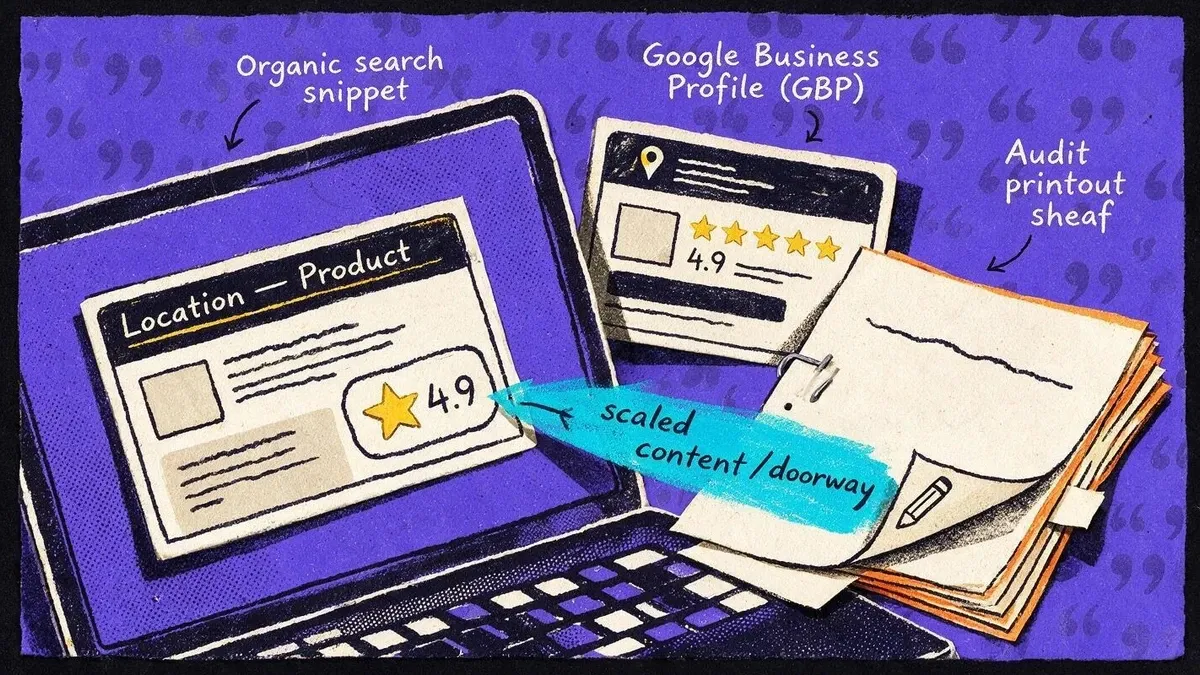
I watched “Google September 2026 Spam Update: Why 1,000 Reviews Won't Save You” from Let’s Talk SEO (https://www.youtube.com/watch?v=GIFaOXUwedc). It’s worth talking about because the September 2026 spam update is live, and I’m still hearing “but we have 4.9 stars” as a defense for organic drops. Reviews and web spam are different surfaces; one doesn’t cancel the other. 🚨 (status.search.google.com)
If you were clipped this month and your defense is “but we have amazing reviews,” you’re arguing conversion, not compliance. Google’s spam systems judge your site’s content and behavior against published policies, not your review count. Reviews can help local pack visibility, not organic ranking of your webpages. (support.google.com)
- Reviews help conversion and local surfacesThey don’t offset spam or low-value content on your website.
- Separate “spam penalty” from “repricing/volatility”Triage first, then fix what’s actually wrong.
- Audit for scaled/templated content, doorway patterns, and site-reputation abuseClean, consolidate, and ship better pages.
- Protect brand presence in AI answersBuild answer-first, citeable content and track brand mentions.
What “1,000 reviews won’t save you” actually means
Let’s draw the line clearly. Google’s spam systems evaluate your site’s content and behavior, not your Google Business Profile review count. Reviews can help with local pack visibility and conversion, but they’re not a ranking shield for organic results. (developers.google.com)
The September 2026 spam climate fits pressure points Google has been explicit about since 2024:
- Scaled content abuse. Generating many near-duplicate pages (locations, SKUs, templated FAQs) to win SERPs without real info gain. Source: Google’s spam policies. (developers.google.com)
- Doorway pages. Multiple pages built to capture variants of the same query and push to the same destination. Source: Google’s spam policies. (developers.google.com)
- Expired domain and site‑reputation abuse. Riding a host site’s authority (or an expired domain) to rank low‑value, off‑topic content. Enforcement began in 2024 and now differs for the EEA after Google’s August 28, 2026 policy update. (developers.google.com)
- Link manipulation. Networks, paid placements without proper qualifiers, footprint‑heavy guest posts. Source: Google’s link‑spam policy. (developers.google.com)
Reviews don’t cancel any of the above. They just don’t.

// My reaction
Reality check: reviews aren't a shield
Fast triage: is this spam, repricing, or normal churn?
Before surgery, confirm the wound. Here’s how I separate causes fast. 🧪
- Check Google Search Console for Manual Actions and Security Issues. If one’s present, remediate against the named policy before anything else. (support.google.com)
- Segment by page type and template. Group by directory, URL pattern, and CMS template. If drops cluster by template, you’ve got a footprint problem, not a sitewide mystery.
- Compare brand vs non‑brand. Brand steady, non‑brand down = quality or spam or intent mismatch on acquisition pages.
- Profile recent links. Look for 90–180 day spikes from low‑relevance domains or obvious networks, then compare to link‑spam policy before acting. (developers.google.com)
- Separate Discover from Search. Discover volatility is normal and uses different systems, don’t treat normal Discover swings as web‑spam enforcement. (developers.google.com)
- Baseline timing. Cross‑check Google’s official ranking history so you’re diagnosing the right event window (the September 2026 spam update began September 24, 2026). (status.search.google.com)
| Symptom | Likely cause |
|---|---|
| Only location pages fell | Templated, thin, or doorway-like patterns |
| Affiliate/comparison pages dropped | Thin overlays, little first‑party insight, link risk |
| Blog stable; programmatic pages down | Scaled content abuse flags |
| Brand fine; generic queries down | Quality/spam signals on acquisition pages |
| Traffic from a few referring domains spiked pre‑drop | Link manipulation risk |
If you need a sharper split between “penalty vs repricing,” I broke that out here: Google September 2026 Spam Update: Is Your Traffic a Penalty or Discover Repricing? (/blog/google-sep-2026-spam-triage)
Audit checklist for this spam climate
What I’d check this week. No fluff, just the work. 📉
- Scaled pages: Sample 50–100 URLs per template. If 80% of words are boilerplate with one swapped token (city, product), you’ve got a problem. Fix the template before rewriting 500 pages. (developers.google.com)
- Doorway risk: If multiple pages chase the same head term and ultimately funnel to one destination, consolidate to a single, comprehensive asset. (developers.google.com)
- Location pages: Require unique inventory or services, true local proof (photos, staff, events), and on‑page actions. NAP blocks and a spun about the city paragraph don’t count.
- Affiliate/comparison pages: Add real testing data, unique criteria, screenshots, and decision support. Thin overlays that mirror merchants aren’t defensible.
- Expired domains and subdomains: Ensure tight topical alignment and editorial control. If not, quarantine or remove. Moving third‑party content to a subdomain doesn’t solve site‑reputation abuse on its own. (developers.google.com)
- Link profile: Export last 6 months. Bucket by topical relevance and footprint. Prune outreach that looks like a scheme, consider disavow only where policy‑risky and impossible to remove. (support.google.com)
- Index hygiene: Noindex thin clusters, merge duplicates, fix canonicals, and clean orphaned junk so crawlers spend time on money pages.
- Logs and crawl budget: If bots hammer low‑value directories, fix internal links and consider robots.txt or disallow where appropriate.
Reviews still matter — but for different reasons
Reviews are conversion catalysts and influence certain local surfaces. They’re also content you can cite on‑page to reduce buyer friction. But they’re not a pass on spam policy or content quality.
Where reviews help in 2026:
- Conversion on landing pages: Pull in verified snippets with context (what problem, which customer segment, where).
- Entity clarity for AI answers: Consistent NAP, services, and proof points make you easier to cite. Use this playbook to make your pages citeable: AI Answers and SEO: Protect Traffic From Clickless Search (/blog/ai-answers-seo-playbook). 🛡️
- Local visibility: Google states local results rely on relevance, distance, and prominence, and that more reviews and positive ratings can help local ranking. That’s local pack or maps, not organic web ranking. Pair with Build Content for AI Search: Answer‑First, Citeable, and Extractable (/blog/build-content-ai-search). (support.google.com)
A 30/60/90 recovery plan I’d actually run
Week 0–2 (containment)
- Freeze risky link building. No new placements until you audit the footprint.
- Noindex or consolidate the thinnest templates. Fix canonicals and internal links.
- Ship 3–5 gold standard pages to set the bar and test. Make them answer‑first with unique data and media.
Days 15–45 (rebuild)
- Rewrite or merge scaled pages into fewer, deeper assets with real info gain, screenshots or video, and clear actions.
- Collapse doorway clusters into single pages aligned to one intent.
- Publish an editorial policy and sourcing notes so quality isn’t a mystery.
Days 45–90 (prove it)
- Earn relevant links through expert commentary and data features, not spray‑and‑pray guest posts.
- Monitor logs, crawl stats, and template rollouts every two weeks. Adjust fast.
- Expand the gold standard pattern across remaining templates.
Need a map for the exact triage and fixes? Start here: Google Rankings Drop September 2026: Triage & Fixes (/blog/google-rankings-drop-september-2026-triage). 🧰
Strong reviews won’t fix weak pages. Fix the pages.
Tooling I trust for triage (current posted prices)
- Screaming Frog SEO Spider: $279/user/year (or £199), with posted multi‑license discounts starting at 5 seats (e.g., £189 per user at 5–9). Useful for template sampling and canonicals. (screamingfrog.co.uk)
- Semrush: SEO plan starts at $139.95/mo, Semrush One Starter (SEO + AI visibility) starts at $199.95/mo. Good for query segmentation and link‑pattern checks. (semrush.com)
- Majestic: Lite plan currently listed at €46.99/mo (or €469.90/yr, ~€39.16/mo equivalent). Handy for historical link graphs. (majestic.com)
Cross‑check vendor pages for the latest plan details before you budget, pricing structures change.
We have 4.9 stars and 1,000 reviews — why did we drop?
Reviews influence local pack prominence and conversion. Web spam systems judge your site’s content and behavior. A strong GBP doesn’t offset scaled content, doorway patterns, site-reputation abuse, expired-domain plays, or link schemes.
Is this a penalty or just Discover being moody?
Diagnose Search vs Discover separately. Discover is a different system with inherently higher volatility. Don’t treat a Discover repricing swing like a webspam problem.
If I move third‑party content to a subdomain, am I safe?
No. Google’s site reputation abuse guidance says moving content to a subdirectory/subdomain doesn’t fix the underlying issue and can be seen as circumvention. The fix is governance and alignment, not just URL shuffling.
How long does recovery take after fixes?
Not overnight. Google reps have consistently said meaningful improvements can take months to reflect, especially after widespread template changes or policy violations.
What specific patterns are risky right now?
Scaled/templated pages with minimal unique value, doorway-like clusters, third-party “parasite” content without oversight, expired domains repurposed off-topic, and link manipulation. All are covered in Google’s spam policies.
The takeaway
This video is right on the core point: reviews won’t save you from the September 2026 spam update. They’re great for trust and local, but the update is adjudicating abusive patterns and low‑value pages. Clean up scaled content, collapse doorway clusters, harden your link profile, and rebuild with answer‑first pages that deserve to rank. Then make those answers easy to cite, see the playbook above, so you keep showing up where users actually get answers and your brand survives the shift to AI‑forward search. 🛠️ (status.search.google.com)
- Google Search Status Dashboard — September 24, 2026 spam update incident
- Google Search Status — Ranking system history
- Google Search Essentials — Spam policies (scaled content, links, expired domains, site reputation abuse)
- An update on doorway pages
- March 2024: Core update and spam policy expansion (~40% low-quality reduction target)
- Google Business Profile help — How local results are ranked (reviews/local surfaces)
- Google Discover documentation
- Help: Discover traffic is volatile
- Site reputation abuse enforcement update for the EEA (Aug 28, 2026)
- Site reputation abuse FAQs (policy clarifications)
- Google says ranking recovery takes months after fixes
- Screaming Frog SEO Spider pricing
- Semrush pricing (SEO + AI Search)
- Majestic pricing reference
references
- Google Search Status Dashboard — September 2026 spam update
- Spam policies for Google Search (scaled content, doorway, expired domains, link spam)
- Update to the site reputation policy (Aug 28, 2026)
- Tips to improve your local ranking on Google (relevance, distance, prominence)
- Google: customer reviews aren’t an organic web ranking factor
- Discover overview: traffic is less predictable than Search
- Disavow links — when and how to use it
- Screaming Frog SEO Spider licence and discounts
- Semrush One Starter price reference
- Semrush — starting price for SEO plan
- Majestic plans and pricing
