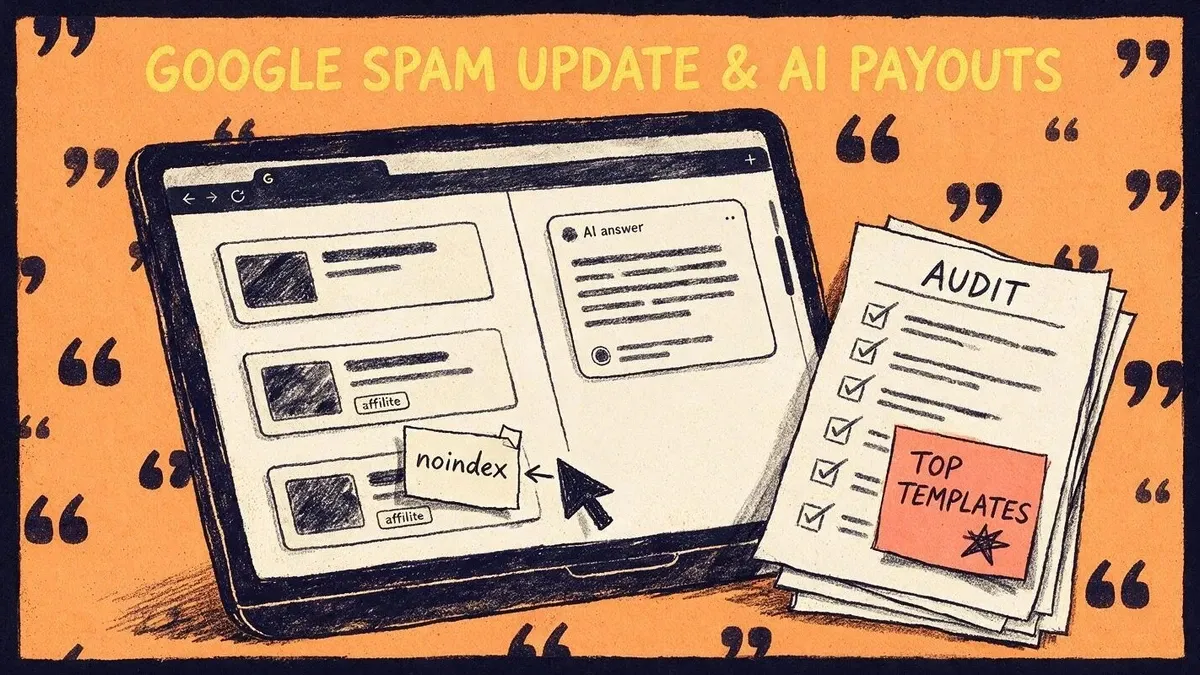
Google’s weekly roundup from Barry Schwartz is out. Here’s the one I watched: Search News Buzz Video Recap (Oct 2, 2026). I watched it because it hits two P&L levers right now: the September 2026 spam update fallout (timeline and “phase two” on Sept 30) and the thin reality of “Google paying publishers” for AI answer use (~100 sites in the pilot; most see ~0.1% of ad revenue). Both affect traffic and revenue. 🎯
Short version: Google’s spam systems are still rolling in waves, not one-and-done (confirmed Sept 24 → 25–27 → 30 roll pattern). And AI payouts are real but small for most publishers, useful signal not a business model (summary, context and $1M outlier report). That’s why this is worth talking about: you need an operator play, not a press release fantasy.

// My reaction
Reaction GIF: mic drop (humorous/sardonic)
- Spam update is still bitingExpect uneven losses; don’t assume a manual action if you see drops. Measure, segment, then act.
- AI payouts are smallDon’t plan a business model around “Google paying you for AI answers.” Build direct value and citations instead.
- Focus on extractabilityMake your content citeable, structured, and technically clean so AI systems can attribute you.
Why this matters for operators
I don’t write about vibes. I care about what to fix Monday morning. Barry’s update underlines two operator truths: traffic from thin/automated pages is fragile under the current spam regime (Sept 24 update; multiple impact waves), and publisher payments for AI use are not a strategy (pilot scale and payout levels). If you were waiting for checks to float your content costs, that’s not a plan.
If you need deeper playbooks, I’ve already published: AI Overviews prevalence and moves in Google AI Overviews: Desktop Prevalence and SEO Moves (/blog/google-ai-overviews-desktop-seo), AI-compensation realities in Google Paying Publishers for AI Answers? What to Do Now (/blog/google-ai-payouts-prepare-now), and spam triage steps in Google September 2026 Spam Update: Will Reviews Save Your Organic Traffic? (/blog/google-september-2026-spam-triage).
What I’m watching this week
AI licensing and payouts won’t save you
Barry frames it plainly: Google isn’t paying much for AI use of your content. Reporting backs that up — about 100 publishers are in the pilot and typical payouts are roughly 0.1% of their ad revenue, with one early participant reportedly on track for >$1M/year while many smaller sites earn <$1,000 over months (SERoundtable summary, Ars Technica write‑up, The Information original). So, plan for minimal or no compensation and push for visibility and citation instead. That means:
- Make answers extractable with crisp sections, bullets, 40–90‑word summary boxes, and schema that matches on‑page truth. Use Article/HowTo where it truly applies. FAQPage is fine for machines, but the visual FAQ rich result is gone (historical change, complete retirement in 2026). 🤖
- Publish original data or contrarian analysis. Models summarize consensus, give editors specifics they can cite.
- Track exposure using Search Console’s Generative AI performance report (official help) and keep a CTR model that assumes low click through from AI surfaces.
Spam update triage without superstition
Treat this like incident response, not mysticism:
- Segment the drop by page template and surface (Search/Discover/News). Discover repricing isn’t a spam penalty, changes like the new “Dive deeper” can shift clicks without a strike against your site (feature test explained). 📉
- Compare patterns against known risk clusters: thin programmatic pages, aggressive affiliate sections, bulk AI rewrites, expired‑domain migrations, UGC/parasite hosts.
- Log‑level reality check: crawl budget spikes? soft‑404s? template duplication? JS render broken? If Google can’t render, you’re not “penalized,” you’re unreadable.
- Don’t ship mass rewrites in a panic. Rewrite a slice, request indexing, measure deltas, then proceed. If you have affiliate‑heavy blocks, fix value density before you touch titles.
If you need a diagnostic fork in the road on Discover vs “penalty,” start here: Google September 2026 Spam Update: Is Your Traffic a Penalty or Discover Repricing? (/blog/google-sep-2026-spam-triage) and tighten your tech ops with Technical SEO for AI Search: Keep, Start, Stop Doing (/blog/technical-seo-ai-search-plan).
SERP pressure from AI answers
Even if you held rankings, clicks can erode under AI answer units (field experiment: AI layers reduce publisher referrals). Also, AIO expansion now touches branded queries and even team rosters, both observed this week (brands, team rosters). And Google keeps toying with citation placement, for example cards at the bottom vs right rail, which matters for clickability (test details).
- Build “summary‑first” modules that answer the main intent in 40–90 words, then expand. 🔎
- Add precise, verifiable claims with citations and source dates in‑line. Make it easy for models to attribute and for editors to justify linking.
- Align editorial with reusable entities (people, places, products). I broke down the extraction angle in SEO Prep for 2027: Make Your Site Citeable and Extractable (/blog/seo-prep-2027-citeable-extractable).
Actions I’d take in the next 7 days
- Pull a by‑template performance diff (last 28 vs prior 28) across Search, Discover, and News. Prioritize the two worst templates. 🧰
- For those templates, audit 10 URLs each: intent match, originality, outbound sources, ad density, affiliate disclosures, and crawl/render health.
- Noindex and regroup obvious thin pages, consolidate near‑duplicates, fix render issues that block main content.
- Add or repair schema that mirrors visible content. If it’s not on the page, don’t mark it up. Remember: FAQ rich results are deprecated, markup can still help understanding, but don’t expect blocks (change notes). 🧪
- Introduce one paragraph‑level “answer box” per key page: 50–90 words, short sentences, a dated citation.
- Draft one original‑data piece (survey, benchmark, pricing table) per core topic cluster. That’s what earns future citations and editorial links.
- Monitor AI visibility weekly for your top 50 “money” queries via the Generative AI report in Search Console, track mentions/impressions alongside CTR (how the report works). If AI units expand, your CTR model should too. For context and measurement ideas, see Google AI Reports: Measure Displacement Before You Change Pages (/blog/measure-ai-displacement-reviews-links).
A quick operator FAQ
Should I delete all AI-written content now?
No. Keep what’s high‑quality, fact‑checked, and useful. Remove or rewrite low‑value, derivative, or mismatched‑intent pieces. Quality and originality matter more than authorship.
Do I need to disavow links after a spam hit?
Usually no. Google says they largely ignore spammy links. Focus on content, technical integrity, and user value unless you knowingly participated in link schemes.
How do I know if it’s a manual action vs. algorithmic?
Check Search Console for notifications. Absent a message, treat it as algorithmic and work the template/content/tech checklist.
Will Google pay me for AI usage of my content?
Don’t count on it. Early payouts look limited and opaque. Optimize for visibility, citations, and owned audience growth instead.
The takeaway
Don’t wait for checks or for the next refresh to “fix it.” Treat the spam update like an outage, triage by template, repair the obvious, and prove value with original, extractable content (spam timeline reference). Fix what’s measured, then expand the fixes. 📝

// My reaction
Reaction GIF: facepalm (frustration)
If you care about staying visible through AI answers, make your content citeable and technically clean, and keep a live view of where AI is already summarizing your space. That’s the practical path for SEO/GEO/AI operations this quarter, and yes, even Google’s own execs are acknowledging the pressure users and publishers feel right now (Nick Fox clip/context).
- Google Search Status Dashboard — ranking updates (Spam Update Sep 2026)
- TNW: Google’s AI contribution pilot reportedly paying ~100 publishers
- Ars Technica: Google is paying ~100 websites for AI Overviews contributions; amounts are tiny, one big outlier
- 9to5Google: AI Overview payout test details; monthly reporting in Search Console
- Google Developers: Generative AI performance reports in Search Console
- Google: AI Overviews — “links to explore more on the web”
- arXiv 2608.04831: Field study — ~1% of AI Overview visits click cited links
- arXiv 2602.18455: AI Overviews reallocate attention away from publishers
- Google Developers: Feb 2026 Discover core update
- Google Support: About Discover — proactive, less predictable
- Google Developers: AI features eligibility — indexable, snippet-eligible pages
- Google Support: Disavow links guidance
- Google Support: Manual actions in Search Console
- Google Developers: JavaScript SEO basics (rendering)
- Google Support: Crawl Stats report
- Google Developers: Structured data policies — must reflect visible content
- Google Developers: FAQ/HowTo changes; FAQ rich results deprecation
- Search Engine Journal: Google drops FAQ rich results from Search
- Search Engine Journal: AI Overviews add more links but many don’t reach the web
