I watched Barry Schwartz’s quick update on YouTube: https://www.youtube.com/watch?v=2NccazpU6bI. It’s worth talking about because it bundles three changes that directly affect how we measure and allocate SEO/Local budgets this week 📊.
Short version: if Google is surfacing a multimodal performance view, there’s signal in that. Ranking volatility hasn’t cooled. And Local Services Ads (LSAs) plus Ads spend are crowding more SERP real estate. See Barry’s volatility post and today’s LSA/paid shifts for context (Search Engine Roundtable; SEL on paid encroachment). (seroundtable.com)
- Treat a multimodal performance filter as marching ordersBuild, mark up, and measure images and video that can win in AI and visual surfaces.
- Assume rolling volatilityRun a 48-hour triage, then a two-week remediation sprint if you confirm real loss.
- Budget pressure from LSAs/Ads is realModel lead mix and protect organic conversion paths before paid cannibalizes them.
What the multimodal performance filter signals
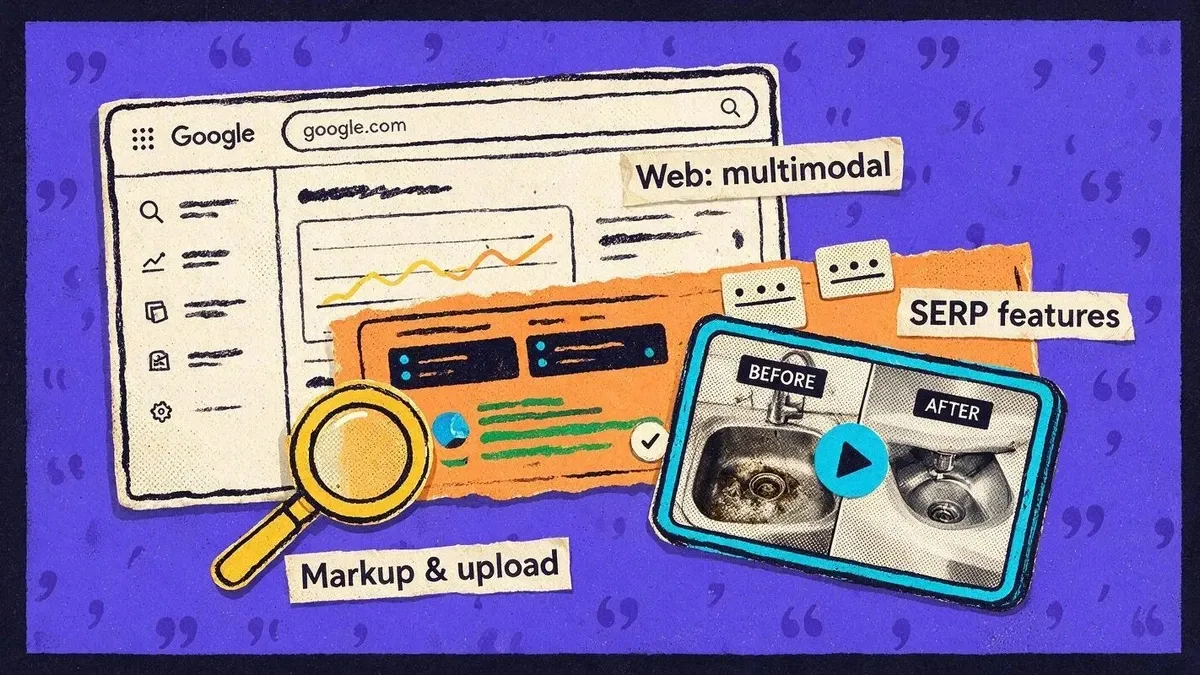
Barry flags a “Web: multimodal” search type in Search Console’s Performance report, covering Lens, Circle to Search, image uploads, and Chrome’s “Search this image” — Google’s doc is linked for context here even if you don’t see it in your property yet (Google Search Central). I read that as a nudge to stop treating media as decoration and start treating images and short video as query-time evidence you can be cited from. You don’t need to wait for a full press release to act. (developers.google.com)

// My reaction
Time to act — multimodal matters
Practical steps I’d start this week:
- Map questions you must win with visual proof. Customer jobs that are easier to show than tell: product how‑tos, service procedures, before/after, diagnostics. 📷
- Ship one page per job with: a tight intro answer, 6–10 annotated images, a 60–120s video, and a summary. Ship answers, not pages.
- Mark up assets with VideoObject, ImageObject, and HowTo where it truly fits. Validate. Then re‑check after you deploy updates.
- Make assets extractable: descriptive filenames, alt that reads like captions, on‑page captions, and full transcripts. Don’t stuff keywords. 🧰
- Track exposure from visual/AI surfaces: compare impressions/clicks under “Web: multimodal” vs the default “Web” type, trend AI Overviews/AI features impressions via the Generative AI Performance report (Search Console help), and monitor CTR deltas on pages after you add media. You won’t get perfect attribution but the direction is what matters. (support.google.com)
If AI answers eat clicks, you still want inclusion and citation. My field playbook is here: /blog/ai-answers-seo-playbook. And if you need build specs that fit AI/visual surfaces, use this template set: /blog/build-content-ai-search. For click‑impact evidence, see experimental findings on AI in search reducing publisher referrals (arXiv). (arxiv.org)
Ship answers your buyer can see, not just text they can scroll.
Does the new multimodal filter include AI Overviews?
No. “Web: multimodal” is a search type for image‑assisted queries (Lens, Circle to Search, uploads, “Search this image”). AI Overviews/AI Mode impressions live in the separate Generative AI report.
Is LSA going away?
No. It’s being folded into Google Ads as a pay‑per‑lead Performance Max variant. Placements remain on Search and Maps.
Will my old LSA reports show in Google Ads after migration?
No. Historical LSA performance reports won’t migrate. Export/download them before transition.
Do I need a Google Business Profile for LSAs?
Yes. A verified GBP is required and core details sync during migration.
Should I pause content work until volatility settles?
No. Run a 48‑hour confirmation, then fix what’s real. Prioritize intent alignment, consolidation, internal links, and structured proof. Waiting won’t stop reshuffles.
- Google Search Console adds “Web: multimodal” search type (Lens, Circle to Search, image uploads, Chrome “Search this image”)
- Search Console Performance report search types (Web: text-based vs Web: multimodal)
- Generative AI performance reporting scope (AI Overviews/AI Mode)
- Google search ranking volatility (Sep 23–24, 2026)
- Keyword.com SERP Volatility Index
- Local Services Ads migration into Google Ads PMax (pay‑per‑lead), budgets, and history
- Where LSAs appear and how they work (Search and Maps)
- New real estate ad formats expanding LSA‑like inventory
- Google Ads budget change “limited by budget” nudges tied to forecasted value
Ranking update: a fast triage, then targeted fixes
Barry flagged significant turbulence today and the trackers backed it up (SER post: Sep 24, 2026). Treat spikes as noise until you confirm a pattern, then move with intent. 🧪 (seroundtable.com)
48-hour confirmation check:
- Confirm the drop: annotate deployments, compare by device and geo, separate brand vs non‑brand. In GSC, segment by page groups/templates, not just queries.
- Identify the cohort: which templates or sections moved together? Service pages in one metro? Directory nodes? Blog clusters?
- Check the obvious: indexation, CWV regressions, robots/meta, canonicals, hreflang, pagination, internal links lost during nav changes.
- Classify the cause: quality (thin/duplicate), intent shift (SERP moved informational ↔ transactional), technical (rendering/internal link decay), or policy (spam‑like patterns).
Two‑week remediation sprint if loss is real:
- Prune/consolidate thin clusters. Merge near‑duplicates. Keep the URL with links/history. 301 the rest. 🧹
- Re‑write for intent. Answer first. Add concrete examples and first‑party proof. Kill filler. No “AI mush.”
- Re‑wire internal links to the one winning URL per topic. Use nav, in‑content links, and related modules. One page, one job.
- Add structured evidence: data tables, screenshots, step photos, citations. Then mark it up with precise schema.
If you need a blow‑by‑blow, use my step‑through: /blog/google-rankings-drop-september-2026-triage. And here’s broader context on why volatility keeps spiking with AI/Ads interleaving: /blog/google-volatility-ai-mode-ads-bidding-update.
Ads spend and LSAs: what it means for local
LSAs and a heavier paid layer change user flows. You can’t will organic back to the top and you shouldn’t plan like you can. 📍

// My reaction
Paid crowding organic — protect conversions
- Measure lead mix by SERP type. For your top 10 money terms, screenshot the SERP monthly and tag slots (LSA, Ads, Map, Organic, AI). Track how many scrolls to reach you. 📈
- Optimize for the surfaces users actually see: GBP completeness, fresh photos, Q&A, service categories. Keep hours and offers current. Reviews cadence matters.
- If LSAs are in your category, expect spillover. Run a pilot with a hard CAC cap. Keep call tracking separate from organic so you don’t misattribute.
- Protect organic conversion: strong CTAs above the fold, click‑to‑call, trust blocks like licensing and insurance and guarantees. If paid grows, you still want organic to close.
I covered why this shift keeps happening here: /blog/google-volatility-ai-mode-ads-bidding-update
Build for AI search now, not later
Multimodal and AI surfaces reward content that’s answer‑first, citable, and extractable. If your templates aren’t set up for that, change them now, not after the next drop. 🧩
- Put the answer up top in 2–4 sentences. Then support with steps, visuals, and sources.
- Add one short video or GIF per task. Label your media like a human would read it.
- Use precise schema. Validate. Re‑check after each deploy.
- Track inclusion and improve iteratively. You won’t nail it in one pass.
My build spec if you want a shortcut: /blog/build-content-ai-search
The takeaway
Barry’s update isn’t noise. It’s a reminder that Google is pushing harder on visual and AI outputs, shaking rankings, and selling more top‑of‑SERP. Respond by measuring multimodal exposure, running disciplined triage during volatility, and hardening local conversion paths. That’s how you keep wins in SEO/GEO while AI keeps changing the SERP. Tie your roadmap and reporting to these surfaces and you’ll keep compounding in 2026, even as SERPs blend AI, media, and ads.
