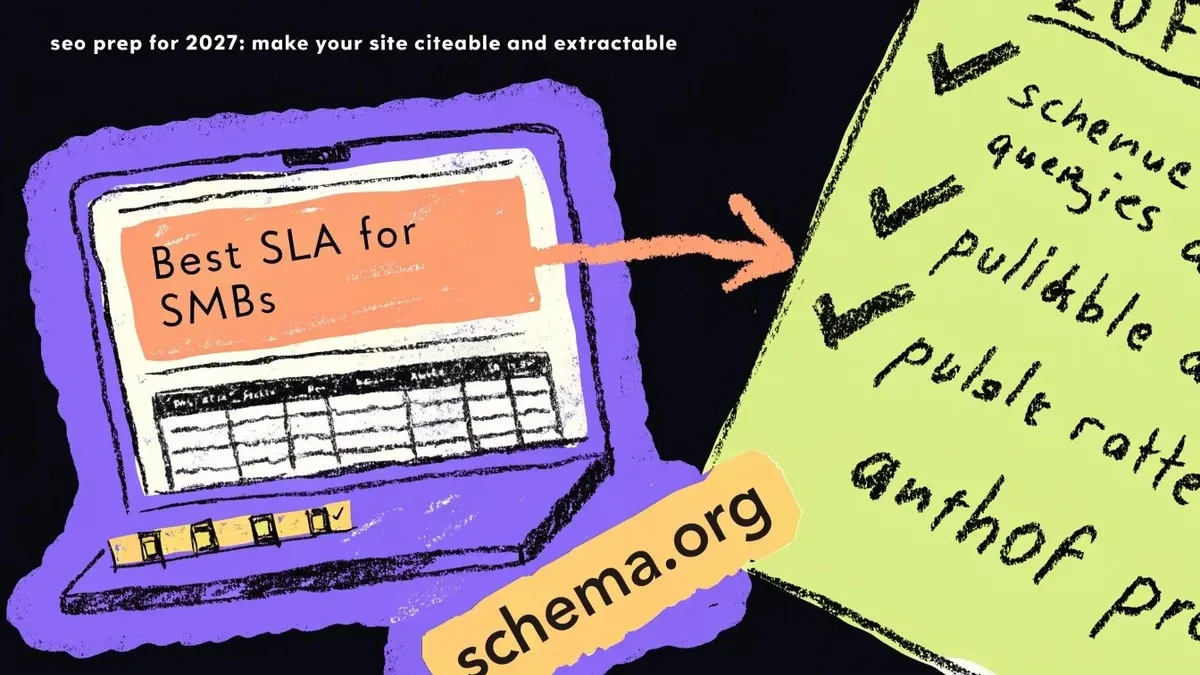
Semrush just shared 5 Ways I’m Preparing My SEO for 2027. Watch it here: YouTube. It’s worth talking about because 2027 planning isn’t guessing the next Google curveball, it’s making your site understandable to humans and machines, and proving you’re the right entity to cite 🧭.
I’m not into forecasts. I care about work you can ship by Friday. So here’s how I’m turning that video into a concrete plan I can measure, with steps that make AI systems quote you and humans actually trust you.

// My reaction
Not into forecasts — give me work you can ship by Friday
- Build for answer enginesStructure content so AI systems can extract, verify, and attribute answers.
- Treat product/service data like codeModel it and publish consistently with Schema.org and feeds.
- Prove the entityTight org/author signals and independent proof beat vague E‑E‑A‑T talk.
- Measure beyond clicksTrack AI visibility and brand demand, not just sessions.
- Build for answer enginesWrite and structure content so AI systems can extract, verify, and cite you.
- Treat product/service data like codeModel, normalize, and publish it with Schema.org and feeds.
- Prove the entityTight org/author signals and third‑party proof beats vague E‑E‑A‑T talk.
- Measure beyond clicksTrack visibility in AI answers and brand demand, not just sessions.
What I’m actually doing now for 2027 readiness
- Shortlist the 20 queries that matter to revenue and map the exact answers/products people need.
- Turn that into page types, structured data, and a publishing/refresh cadence you can keep.
- Instrument visibility and brand lift before you rewrite anything, so you can show deltas later.
Prioritize content that wins in AI answers
If an AI system quotes you, it’s because your page makes the answer obvious, checkable, and attributable. That means:

// My reaction
When AI quotes you, you win
- Lead with the answer, then show methodology and sources. Use tight sections, Q&A, and clear claims. 📌
- Add inline definitions, inputs/outputs, and constraints. Make it easy to compare.
- Publish original artifacts: calculations, checklists, tables, and small tools, things that are hard to paraphrase.
- Cross‑link supporting proof: author bios, org details, case evidence, and sources.
Google says there’s no special markup for AI Overviews/AI Mode, solid fundamentals win (see AI features and your website). (developers.google.com) But AI Overviews and similar features change how answers get assembled and cited, and zero‑click outcomes are rising (about 68% of U.S. Google searches ended without a click Jan–Apr 2026 per Similarweb panel data via SparkToro; coverage via Search Engine Land) (SparkToro; Search Engine Land). (sparktoro.com) So design for extractability and attribution, not just rankings. Use this playbook to structure pages for AI answers: AI Answers and SEO: Protect Traffic From Clickless Search (/blog/ai-answers-seo-playbook). For AO‑specific tactics and examples, also see AI Search vs SEO: How to Get Cited by AI Overviews (/blog/ai-search-get-cited-by-ai-overviews).
Use this playbook to structure pages for AI answers: AI Answers and SEO: Protect Traffic From Clickless Search. Then watch how often you surface in AI outputs with the AI Visibility Checker.
Do I need special schema to appear in AI Overviews or AI Mode?
No. Google says there’s no AI‑specific schema or files required. Keep fundamentals strong and cite your sources.
Is structured data a ranking factor?
No. It can enable rich results and clarify meaning, but eligibility is not guaranteed and it’s not a manual‑action ranking boost.
How do I measure AI citations today?
In Bing, use the AI Performance report for citations and queries. For Google, pair GSC impressions, referrer analysis, and a GA4 proxy for AI traffic until more native reporting exists.
Should I still use rel=prev/next for pagination?
Google hasn’t used it in years. Focus on UX‑sound pagination, self‑canonicals where appropriate, and discoverability via internal links and sitemaps.
What’s the fastest way to start this?
Pick your 20 revenue queries, define the answer and artifact each needs, map schema fields, and schedule two sprints: one for content/artifacts, one for data modeling and markup.
- Semrush video: 5 Ways I’m Preparing My SEO for 2027
- Google: AI Overviews launch (May 2024)
- Google: New AO link behaviors (Aug 2024)
- Google: AI features guidance (no special schema)
- SparkToro: 2026 zero‑click analysis (Similarweb panel)
- arXiv (May 2026): AO citation source selection vs. rankings
- arXiv (Feb 2026): AI summaries and traffic displacement
- Bing Webmaster Tools: AI Performance report
- Google: Product structured data
- Google: Structured data policies
- Google: Consolidate duplicate URLs (canonicals)
- Google: Pagination and incremental loading
- Google: Creating helpful content (E‑E‑A‑T guidance)
Product and service data as first‑class assets
Don’t bury the good stuff in prose. Pull your attributes into a source of truth and publish them consistently:
- Normalize attributes (model, dimensions, SKU, certifications, compatibility, service tiers, SLAs). 📦
- Map each attribute to first‑party data fields and expose them via Product/Service/Offer schema and feeds.
- Keep identifiers stable across site, feeds, and docs. No duplicate SKUs, no drifting names.
Sanity‑check your structured data with the Schema Opportunity Analyzer. You’ll find missing properties and page types worth templating.
Build entity clarity and brand proofs
AI systems assemble an entity picture from your site, profiles, and independent mentions. Tighten it:
- Organization schema with sameAs to the core profiles you control. Authors with real bios, roles, and topic focus. 🧩
- A focused About page: who you are, what you do, where, and proof (awards, certs, partners) with links that resolve.
- Get two to three defensible third‑party citations per quarter: industry directories, standards bodies, or earned coverage. Start here: AI‑Assisted PR Outreach Workflow That Keeps Control.
Technical debt: crawl control and structured context
Crawlers and answer engines can’t respect what they can’t parse or find:
- Canonicals and pagination that match intent. No mixed signals across near‑duplicates. 🔧
- Sitemaps by type (core pages, listings, articles, feeds) with lastmod that actually updates.
- Speed budgets and HTML that ships the content early (server side render where it counts; hydrate later).
- Kill thin endpoints. Consolidate fragments into useful, linkable pages.
If this is dusty in your org, book a fast pass: SEO Audit.
Measurement that survives clickless answers
Clicks will be unreliable. Direction matters more than totals:
- Track branded search demand and mention share alongside sessions. 📊
- Log answer‑engine visibility over time (queries, surfaces, and if you’re cited). Use the AI Visibility Checker to trend it.
- Attribute lifts by page type and entity signal (e.g., author pages improved → more citations on expertise topics).
- Keep an “evidence register” per key page: last refresh, added proof, structured data changes, outcome.
Team and workflow changes
Strategy is cheap if ops can’t ship it:
- Content briefs must include: primary claim, counter‑claim, the table/tool to include, schema spec, and internal proofs. 🧪
- Dev tickets reference the same data model and schema fields as content. No one off fields.
- Editorial QA checks for extractability: Is the answer explicit? Is the source named? Is the table parseable?
Takeaway
You don’t need predictions to prep for 2027. You need clearer answers, cleaner data, and repeatable ops. That’s what AI systems and evaluators both reward. Start with your top 20 queries, model the data behind those answers, and ship pages that are trivial to cite. Then measure visibility, not just clicks. That’s the throughline for durable SEO/GEO/AI practice.
