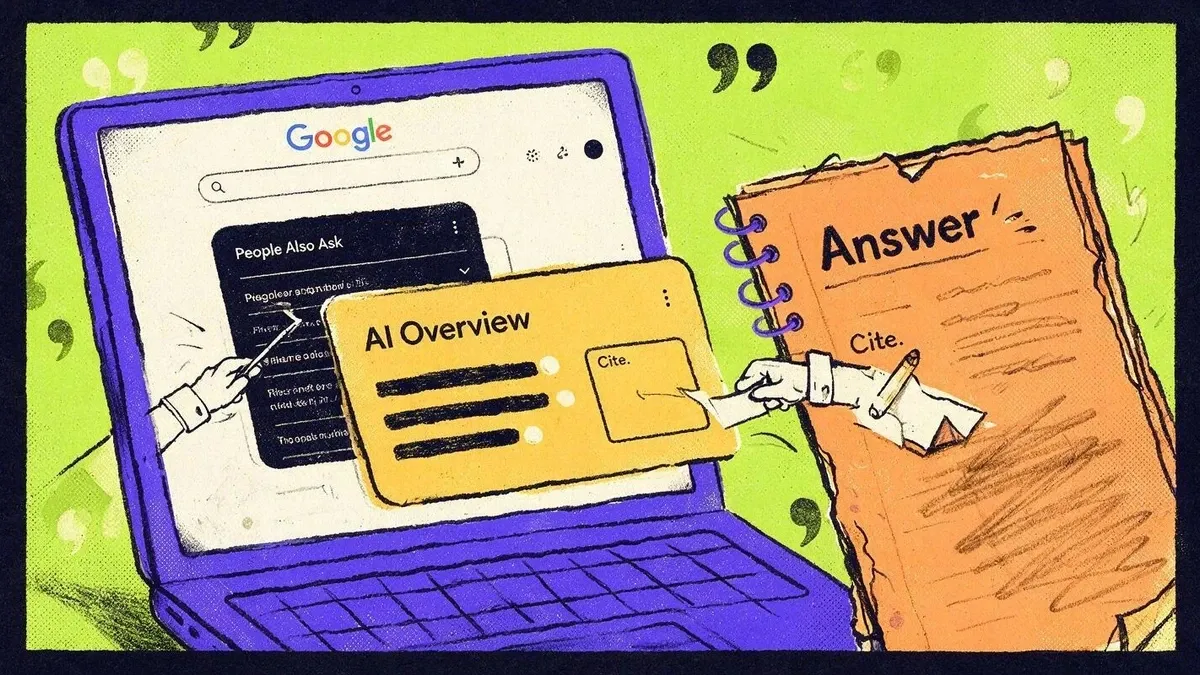
Candour’s latest update on AI search (video: https://www.youtube.com/watch?v=A_nXjLlxihw) is worth your attention because it hits two levers that move traffic fast: AI Overviews showing up where People Also Ask once fed discovery, and early signals of a publisher payment test. If you sit on mid‑funnel portfolios, that combo changes clickflows and editorial planning overnight. 👀

// My reaction
Surprised GIF
Short version: don’t wait for a “full rollout,” and don’t pad content. Make your answers extractable and citeable or get squeezed. I’ll show you a 7‑day ship list, a fixed‑cohort measurement loop, and a readiness brief so you can act in hours, not weeks.
- AIO in PAA slotsCandour reports AI Overviews showing where PAA often appeared; that compresses question traffic and raises the bar for being cited.
- Content responseBuild clean, extractable answers with clear entities, references, and tight intros. Don’t pad.
- Measurement nowTrack AIO presence vs. clicks. Sample SERPs weekly and annotate traffic swings.
- Payments testTreat as optional upside: identify inventory, owners, and terms you can live with.
What changed and why it matters
Candour’s team highlights two shifts: AI Overviews appearing in placements where PAA commonly showed, and signs Google may be testing a publisher payment program. Independent tracking shows that by early September 2026, about 97% of revealed PAA answers were AI‑generated in an AI Overview style (vs ~86% in August and ~12% ~14 months earlier) seroundtable.com, seohandbook.co.uk. (seroundtable.com) 🔎
- PAA isn’t “gone,” but its utility for discovery changes if the revealed answers are model‑written and labeled as AI Overviews inside the PAA module. Your page either becomes a cited source or zero‑click answers soak up the curiosity layer. BrightEdge’s tracking has AI Overviews triggering on nearly half of monitored queries, while organic still drives the majority of search activity; multiple reports show CTR compression when AIO is present brightedge.com, searchengineland.com. (brightedge.com)
- The practical response: make your content answerable, not just comprehensive. Your goal is to be citeable and extractable. Start there, then expand. If you need a refresher on tactics aimed at AI answers, read AI Answers and SEO: Protect Traffic From Clickless Search (/blog/ai-answers-seo-playbook).
Ship list for the next 7 days
1) Map where AIO appears on your queries
- Pull your top 200 question and how‑to queries. Check desktop and mobile. Record if AIO shows at the top or inside the PAA expansion region and capture the cited domains.
- If you need a process, I laid out measurement guardrails here: Google AI Reports: Measure Displacement Before You Change Pages (/blog/measure-ai-displacement-reviews-links).
2) Make pages extractable
- Lead with a 1–3 sentence answer block at the top. Then details.
- Use tight headings that mirror query language. One idea per H2/H3.
- Add source references near claims and data. You don’t need 20, you need the right 2.
- Mark up with Article (or HowTo/Recipe/QAPage where appropriate). Include author, datePublished, and sameAs on org/person. Keep it clean. 🧪
3) Strengthen entity clarity
- Define the primary entity early (what it is, how it relates, where it differs from adjacent terms). Link to a canonical reference when it actually helps.
- Cross‑link to your core explainer hubs so the model sees context, not orphans.
4) Target “citable snippets”
- Add a short TL;DR with facts, definitions, ranges, or step counts that a model can lift without hallucinating. Keep it maintained.
Measurement that won’t lie
- Build a weekly SERP sample: 100–200 fixed queries. For each, track AIO presence (Y/N), placement (top/mid/PAA), and cited domains. Pair this with your classic rank/feature tracking. 📊
- Annotate analytics on days your sample’s AIO presence changes. Expect CTR compression when AIO expands searchengineland.com. (searchengineland.com)
- Use Search Console’s Generative AI performance reports, launched June 3, 2026 and rolled out globally by August 31, 2026, to monitor AIO impressions by page/country/device developers.google.com, support.google.com. (developers.google.com)
- Note the data‑logging bug that reduced reported AIO impressions on August 13–17, 2026; Google says this affected reporting only and restored the data on August 21 support.google.com, searchengineland.com. (support.google.com)
- Keep a fixed cohort of URLs. Compare periods with and without AIO present on your sample to isolate seasonality and update noise.
Decision guide
If AIO is present
- Optimize for citations first; expand depth after.
- Add an answer block and references above the fold.
- Monitor competitor citations and adjust your references.
If AIO is absent
- - Capture PAA‑like demand with scannable Q/H2s and internal links.
- - Ship broader topical coverage to earn related queries.
- - Test richer media (images, steps) for Featured Snippets.
Publisher payments: treat as optional upside
Reports point to an invite‑only Google “AI contribution” pilot paying some publishers when their content “significantly contributes” to answers across Gemini, AI Overviews, and AI Mode. There’s no public rate card; payments are framed as value‑based contributions, not simple per‑citation or per‑view payouts digiday.com, searchengineland.com. (digiday.com) 🧾

// My reaction
Contemplative GIF
- Inventory likely “deal” pages: authoritative explainers, original data assets, and long‑tails already cited by AIO.
- Assign owners, set minimum terms you’ll accept, and define what you won’t do (e.g., exclusivity by topic).
- Keep a readiness brief with contacts and analytics per asset so you can respond quickly. If the program expands, use this 72‑hour triage: Google Paying Publishers for AI? 72‑Hour Triage & Readiness Playbook (/blog/google-ai-publisher-triage).
Team workflow I’d run
- Week 1: Query mapping, AIO sampling, pick 25 pages to fix.
- Week 2: Ship answer blocks, references, and internal link cleanups on the 25. Start a citation watchlist of competitors.
- Week 3: Expand to 50 more pages. Add entity clarifications and TL;DRs. ⚙️
- Week 4: Review KPIs from the fixed sample, compare AIO vs non‑AIO periods, adjust targets. Decide on the next 50.
Be first to be useful. If AIO pushes into PAA space, you don’t argue with it — you feed it the clearest, most defensible answer on the web.
Is PAA gone?
No. PAA still renders widely, but the revealed answers are now mostly AI‑generated in many markets. Recent snapshots show extremely high AI rates inside PAA while overall PAA prevalence still varies by region and dataset.
Should I wait for a full rollout before changing templates?
No. Ship answer blocks and references on a fixed set now and measure. Waiting costs you data and time you won’t get back.
Does schema help with AIO citations?
Indirectly. Clean Article/HowTo/QAPage with author/date and coherent entity signals help models and evaluation systems understand your page. It’s not a guarantee of citation, but sloppy markup hurts.
If I’m cited in an AIO, will I get paid under the pilot?
Not based on current reporting. Payment hinges on “significant contribution,” not a visible citation. Track citations separately from any licensing conversations.
How do I measure AIO impact without chasing noise?
Use a fixed SERP cohort, track AIO presence/placement and cited domains weekly, and annotate analytics. Pair this with GSC’s Generative AI reports and your internal query demand models.
The takeaway
If AI Overviews are eating into PAA real estate, your mid‑funnel compresses and weak answers die. Tighten your intros, clarify entities, cite sources, and measure on a fixed query set so you’re not guessing. Then keep shipping. For the bigger play, align your content so it’s both citeable and extractable: SEO Prep for 2027: Make Your Site Citeable and Extractable (/blog/seo-prep-2027-citeable-extractable).
This is SEO/GEO/AI practice: ship measurable tests, build for machines and humans, and be ready when product and policy shift under your feet.
- Candour Agency — AI Overviews takeover People Also Ask & Google tests publisher payment program (https://www.youtube.com/watch?v=A_nXjLlxihw)
- SERoundtable — 97% of PAA answers are AI-generated (https://www.seroundtable.com/ppa-ai-overviews-google-42047.html)
- SEO Handbook — July 2025 baseline for AI in PAA (~12.6%) (https://seohandbook.co.uk/seo-news-updates/people-also-ask-ai-generated-97-percent/)
- BrightEdge — AIO presence and click behavior (https://www.brightedge.com/resources/weekly-ai-search-insights/ai-overviews-one-year-presence-size-citing)
- Search Engine Land — CTR declines as AIO exposure rises (https://searchengineland.com/google-ai-overviews-search-clicks-fell-report-455498)
- Google Developers Blog — Generative AI performance reports in GSC (https://developers.google.com/search/blog/2026/06/gen-ai-performance-reports)
- Search Engine Land — GSC Generative AI report logging bug (https://searchengineland.com/google-search-console-generative-ai-performance-report-in-search-data-bug-485215)
- Digiday — Google’s “AI contribution” pilot details (https://digiday.com/media/google-rolls-out-pay-value-ai-licensing-program-to-publishers/)
- Search Engine Land — Reports of Google paying select publishers (https://searchengineland.com/google-tests-paying-publishers-for-using-its-content-in-ai-mode-ai-overviews-and-gemini-488382)
