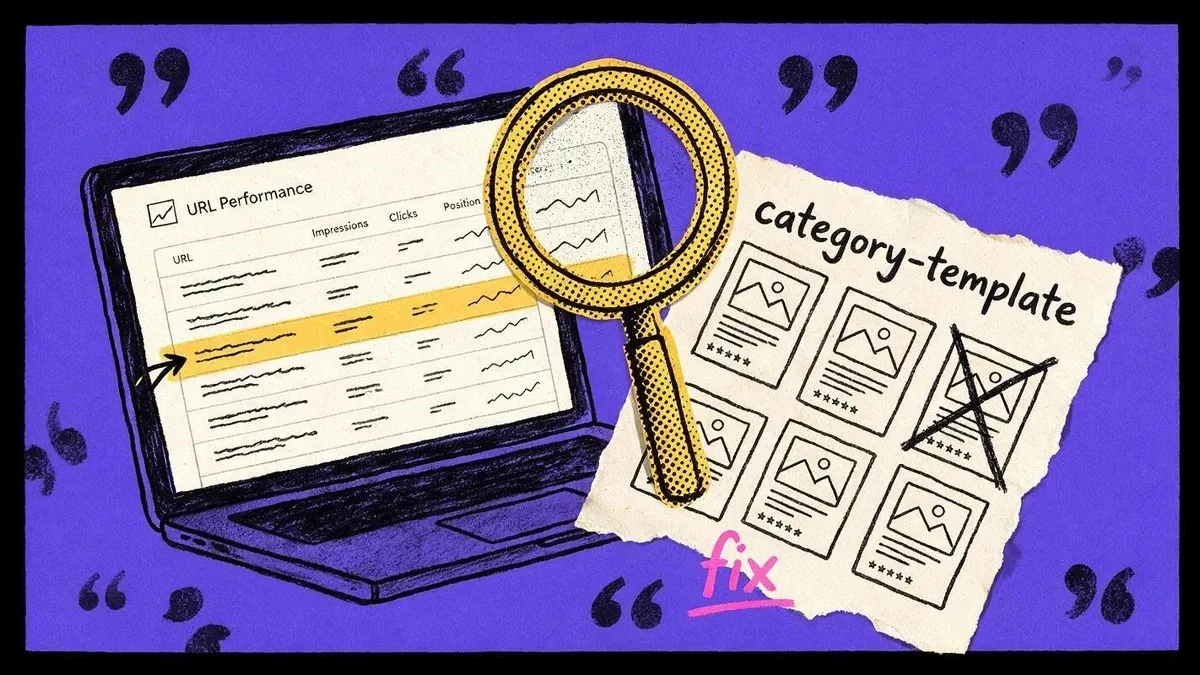
- If your drop lines up with early–mid August and clusters to thin/programmatic pages, treat it like a spam update hitconfirm in GSC by page type, fix at the template level, and remove anything you wouldn’t defend on a manual review call.
Do now
- Remove/noindex thin clusters
- Consolidate and republish one strong page per topic
- Fix nav/related links to prefer canonicals
- Add real-world data (pricing, inventory, field photos, citations)
- Refresh structured data to match on-page facts
- Re-audit crawl paths and thin category/tag pages
You can’t scale nothingness. If a template can’t carry facts, don’t publish it 500 times and hope links fix it.
Was the August 2026 event a “link spam” update?
Google labeled it a “spam update,” not “link spam.” Diagnose against policies like scaled content abuse, site reputation abuse, expired domain abuse, and doorway/redirect abuse (see Google’s dashboard and spam policies).
Is AI content banned now?
No. Google targets scaled content abuse regardless of how it’s made. AI is fine if the primary purpose is to help users, not manipulate rankings (Google’s March 2024 policy updates).
Should I use the disavow tool?
Only if you have a manual action for links or you knowingly built unnatural links you can’t get removed. Google says most sites won’t need it.
Could GSC/GA4 bugs explain my drop?
Maybe in part. There was a Generative AI report anomaly Aug 13–17 in GSC. Segment by template and confirm the timing before you rip out content.
How long does recovery take?
No guaranteed timeline. If you fix template-level issues and remove abusive patterns, you can see crawling and indexing stabilize fast; rankings follow with the next spam/calc refresh. Focus on information gain and policy compliance.
- Google Search Status Dashboard — Spam updates history
- Search Engine Land — Ranking impact snapshot (SE Ranking data)
- Search Engine Land — Update done rolling out (Aug 21, 2026)
- Search Engine Journal — Google begins rolling out the August 2026 spam update
- Google Search Central — March 2024 core update & spam policies
- Google — Spam policies (scaled content, expired domains, doorways, redirects)
- Google — Site reputation abuse policy updates
- Google Support — Manual actions in Search Console
- Google Support — Disavow links guidance
- Google Search Central — Generative AI performance reports
- Search Engine Land — GSC generative AI data bug coverage
- FTC — Updated Endorsement Guides (2023)
- FTC — Final rule banning fake reviews/testimonials (effective Oct 21, 2024)
- YouTube — Tim The SEO Guru: Google’s August Spam Update: 4 Sites Got Hit Hard! (What NOT to do)
I watched Tim The SEO Guru’s breakdown of Google’s August spam update and the four sites that got crushed. Here’s the video: https://www.youtube.com/watch?v=xkIqItBwGJA. Worth your time because he’s calling out patterns I’m seeing in audits right now and if your traffic slid this month you need to separate spam issues from AI-answer displacement fast or you’ll start deleting pages you actually needed 👋
I’m Yerain, I fix messy content systems for a living and I don’t guess. This update isn’t mystical. It punishes repeatable, at-scale tricks that add nothing new, and it’s fixable if you diagnose by template and intent, not vibes. Let’s make this practical and move.

// My reaction
Yerain drops the truth
What stood out and what I’d check first
Tim’s teardown of four hit sites is a useful reminder: Google keeps cracking down on repeatable, at-scale tricks. Whether you run affiliate, local, or UGC-heavy content, here are the site-level patterns most likely to get hammered right now:
- Template-thin, mass-produced pages: same outline, swapped nouns, no new facts. If AI wrote it and you didn’t add real info gain, expect volatility.
- Expired-domain or junk redirect schemes: redirecting old domains purely to pass authority, or shotgun 301s into irrelevant pages.
- Programmatic pages with keyword shingling: hundreds of near-duplicates (city/service, product/attribute) with zero unique data signals.
- Aggressive doorway structures: hub pages that exist only to funnel to a single monetized URL.
- UGC indexed without quality guardrails: profiles, classifieds, reviews—indexable and thin, often linking out.
- Parasite placements: content on third-party authority sites that’s off-topic or promo-first.
- If your drop lines up with early to mid August and clusters to thin or programmatic pages, treat it like a spam update hitconfirm in GSC by page type, fix at the template level, and remove anything you wouldn’t defend on a manual review call.
🔍 Don’t overfit to one example. You’re looking for families of URLs that share the same template and intent. Fix the template, not just a page.
The quick checkup I actually run
If you need a step-by-step, this is my current checklist: August 2026 Spam Drop? The Check-Up I Actually Run. Short version:
- Map the loss by URL pattern. Group by folder, template, and content type. If 70%+ of the loss is one template, you found the culprit.
- Compare word count vs. facts added. If the page says a lot but tells me nothing I couldn’t guess, it’s thin.
- Remove or noindex the worst offenders first. 🧹 Keep crawlers off deadweight while you rebuild.
- Collapse near-duplicates. Consolidate 5 shallow pages into 1 citation-ready page with real sources and data.
- Kill deceptive redirects. If a redirect can’t pass a “user intent stayed the same” sniff test, delete it.
- Rate-limit programmatic output. If you can’t add facts at scale (inventory, pricing, regulatory, local data), don’t ship it at scale.
How to confirm you weren’t displaced by AI answers
Spam hits and AI answer displacement can look identical in analytics. Before you rewrite half the site, separate them:
- Build an AI-search proxy in GA4 to spot query classes now answered by AI: Track AI Search Traffic in GA4 — How to Build a Defensible Proxy. 🤖
- If review snippets, comparison tables, or “best X for Y” pages cratered, quantify AI displacement and rethink page purpose: Google AI Reports: Measure Displacement Before You Change Pages.
- In GSC, filter by URL group. If mostly informative listicles lost position but deep how-tos held steady, you may be looking at AI summaries stealing clicks, not a penalty. 📉
If the drop is template-specific, starts mid-August, and the remaining pages still crawl and index fine, it’s probably the spam work, not just AI cannibalizing clicks.

// My reaction
Diagnosis complete
If you were hit, recovery priorities
Work in this order. Move fast, don’t be sloppy:
- Delete or noindex the worst 10–20% of pages by quality. Don’t wait for a perfect rubric.
- Ship one “definitive” replacement per collapsed cluster. Make it citation-ready with sources, dates, and claims you can defend.
- Rework internal links to surface the new canonical pages. Point legacy links through the strongest page, not a maze of near-duplicates.
- Clean redirects. Keep only those that preserve user intent and topical continuity. Everything else goes.
- Only consider disavow if you have a manual action for links or you knowingly bought spam links. Otherwise, it’s a distraction.
Do now
- Remove/noindex thin clusters
- Consolidate and republish one strong page per topic
- Fix nav/related links to prefer canonicals
- Add real-world data (pricing, inventory, field photos, citations)
- Refresh structured data to match on-page facts
- Re-audit crawl paths and thin category/tag pages
Local and affiliate notes
- Local: doorway-ish city or service pages with no unique proof like photos, permits, SKUs, service radius, crew bios are fragile. Add receipts or consolidate.
- Affiliate: comparison pages need verifiable specs, update logs, and outbound citations. If it reads like a brochure, it’s toast. ⚠️
You can’t scale nothingness. If a template can’t carry facts, don’t publish it 500 times and hope links fix it.
Takeaway
Spam updates punish scale without substance. Start by confirming the drop isn’t just AI answer displacement, then fix issues at the template level and strip anything you wouldn’t defend on a screen-share with a spam fighter. That’s how you stop the bleeding and earn back trust. The work loops right back to SEO, GEO, and AI practice: quantify the cause, tune templates to add information gain, and instrument analytics so your decisions aren’t guesses.
