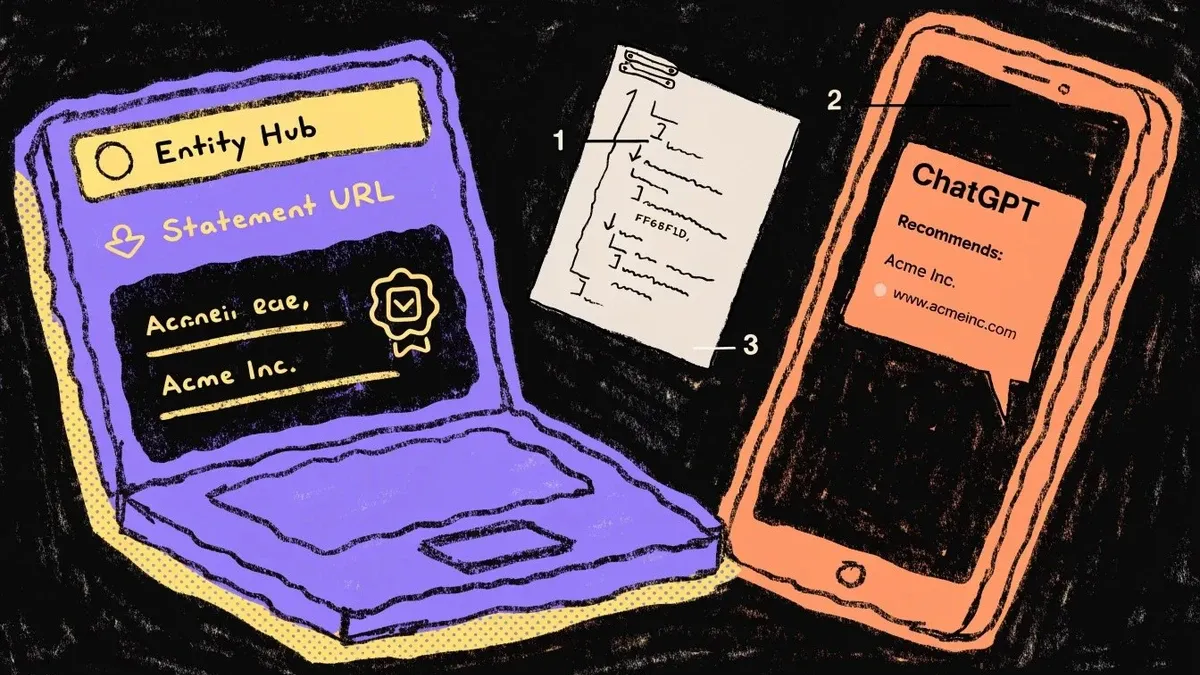
Most of us aren't losing traffic to competitors, we're losing it to answers. This talk from The Marketing Meetup — AI Search visibility: how to get your brand recommended by LLMs (https://www.youtube.com/watch?v=Wji8tKnCr2o) — is worth a close read because assistants are where buying journeys start now. If they don't name you, your funnel never opens. 👀

// My reaction
Reaction: curious/concerned glance
They’re not just reading pages, they’re forming entity level priors and pulling short, citeable facts. That’s fixable with the right assets and markup, and it’s way more procedural than mystical if you treat your brand like a data object and ship proof.
- LLMs recommend entities, not just pagesTreat your brand as a data object with corroboration across the web.
- Build citeable proofPublish short, verifiable statements with sources and stable URLs.
- Expose machine-readable factsUse precise schema for org, offers, specs, credentials, and reviews.
- Measure weekly in modelsTrack prompts across ChatGPT, Gemini, Claude, and Perplexity with location and intent variants.
- LLMs recommend entities, not just pagesTreat your brand as a data object with corroboration across the web.
- Build citeable proofPublish short, verifiable statements with sources and stable URLs.
- Expose machine readable factsUse precise schema for org, offers, specs, credentials, and reviews.
- Measure weekly in modelsTrack prompts across ChatGPT, Gemini, Claude, and Perplexity with location and intent variants.
What LLM recommendations actually mean
Models don’t act like a ten blue links SERP. They:
- Infer who or what you are from first and third party data, that’s entity resolution.
- Keep rough reputational priors like are you safe, local, credible for this task.
- Extract small facts like names, roles, prices, certifications, service areas, comparisons.
- Sometimes cite sources, sometimes not. Plan for both, be citeable and still recognizable when uncited.
So the job is twofold. Make your entity easy to verify, and make key facts trivial to extract.
"Google ranks pages. AI names brands. Two different systems, two different jobs."
Why this matters now:
- Consumer panels show AI tools leading discovery and research stages. In one January 2026 panel, 35% started discovery in AI vs 13.6% in search (source: Similarweb’s AI consumer journey study). (aisearch.similarweb.com)
- Google AI Overviews (AIO) shows up on a large share of queries and often cites sources that don’t rank top 10, which breaks the old rankings = visibility assumption (sources: BrightEdge AIO one year review, overlap analysis PDF). (help.brightedge.com)
- Cross engine audits consistently find most citations come from third party pages, not the vendor’s site — see independent analyses like ClearCited. (clearcited.com)
Links:
- Similarweb: aisearch.similarweb.com/blog/ai-consumer-journey/
- BrightEdge: brightedge.com/resources/weekly-ai-search-insights/ai-overviews-one-year-presence-size-citing
- ClearCited: clearcited.com/research/state-of-ai-search/
What to build in the next 30 days
An entity home that machines can verify
- Your About or Company page is your entity hub. Include legal name, DBA, founding year if you’re comfortable, leadership names, service areas, and contact channels. Keep it short, factual, and link out to key profiles.
- Add Organization or LocalBusiness JSON LD with name, url, logo, sameAs restricted to strong profiles, contactPoint, areaServed. Keep it accurate, don’t guess.
- Use stable IDs. If you change slugs, redirect, don’t duplicate.
Create citeable proof pages
- Build single purpose URLs for claims assistants can quote like pricing, certifications, Methods, Data Sources, Warranty, Shipping and Returns, and a short Why us for [use case] page.
- Put the claim in plain text near the top and mirror it in JSON LD where appropriate. Give each claim its own paragraph anchor, assistants parse anchors well.
- Publish comparisons only where you have firsthand basis like your feature vs a general category. Don’t speculate on competitors.
Make your product or service extractable
- Product or Service schema with name, description, sku or model, brand, offers with priceCurrency, price, availability, and clear spec properties. If a property exists in schema.org like power, dimensions, compatibility, use it.
- For services, mark serviceType, areaServed, provider, and the actual deliverables. Avoid vague copy. Be literal.
Collect and expose first party evidence
- Add verifiable stats like counts, last updated stamps, methodology blurbs. If you cite your own numbers, link the raw method page.
- Reviews, use native collection if allowed in your space. Mark up with AggregateRating only if policy compliant and visible to users per Google SD policies.
- Case studies, include client type, problem, steps, measurable outcome. Keep screenshots or redacted proofs.
Earn third party corroboration
- Target 5 to 10 high signal sources for your niche like standards bodies, industry directories, partner marketplaces, respected media. Get consistent NAP, descriptions, and links back.
- Contribute primary material like studies, datasets, or how tos others will cite. That’s how you become the answer, not just an option.
Technical musts so AI can read you
If assistants can’t fetch and parse your facts, they’ll source them somewhere else.

// My reaction
Reaction: frustrated realization
- Allow the right bots. OpenAI documents separate user agents for search indexing vs model training, you can allow OAI SearchBot while disallowing GPTBot (OpenAI crawlers doc). Anthropic documents ClaudeBot and how to block it (Anthropic help). Perplexity publishes guidance for PerplexityBot or User and WAF rules (Perplexity guide). Control via robots.txt and your WAF or CDN. (developers.openai.com)
- Match schema to what’s visible. Misaligned or invisible structured data can lead to loss of rich results eligibility in Google, keep markup truthful and minimal (Google structured data guidelines). (developers.google.com)
- Measure first, then ship. AIO presence shifts, not every AIO click is a click at all. Treat being named and description accuracy as leading indicators. BrightEdge shows AIO often cites non top 10 sources (BrightEdge one year review), Similarweb shows AI dominating early funnel behavior (Similarweb study). (help.brightedge.com)
Docs:
- developers.openai.com/api/docs/bots
- support.anthropic.com/.../does-anthropic-crawl-data-from-the-web-and-how-can-site-owners-block-the-crawler
- community.perplexity.ai/.../updated-guide-perplexity-crawlers-aws-waf-setup
- developers.google.com/search/docs/appearance/structured-data/sd-policies
If you want the operational checklist for this, I wrote it up here: Technical SEO for AI Search: Keep, Start, Stop Doing (/blog/technical-seo-ai-search-plan).
How to measure AI visibility weekly
I don’t guess. I test the models directly, same prompts, every week.
- Build a short test suite like Who are the best [service] providers in [city], Which [product] is best for [use case], Who offers [service] with [requirement]. Include informational and commercial intent.
- Test on ChatGPT, Gemini, Claude, and Perplexity. Do signed in and signed out where possible. Use incognito or temporary chats to reduce personalization effects — both OpenAI and Anthropic document memory or personalization features that can influence responses (ChatGPT Memory, Claude personalization). (help.openai.com)
- Geo bias matters. Run with a city or state hint and without. Some assistants infer location, some don’t. 📍
- Record whether you’re named, how you’re described, and any citations shown. Save screenshots and URLs.
If you want a head start, this is exactly what my free AI Visibility Checker tracks on a simple cadence: AI Visibility Checker (/tools/ai-visibility). Pair it with structured data gaps from the Schema Opportunity Analyzer (/tools/schema-analyzer). 🧪
| Check | Where |
|---|---|
| Brand named in top 3 suggestions? | ChatGPT / Claude |
| Any citation from your domain? | Perplexity / Gemini |
| Is description accurate and current? | All four |
| Location inferred correctly? | ChatGPT / Gemini |
| Check | Where |
|---|---|
| Brand named in top 3 suggestions? | ChatGPT / Claude |
| Any citation from your domain? | Perplexity / Gemini |
| Is description accurate and current? | All four |
| Location inferred correctly? | ChatGPT / Gemini |
What good looks like after 4 to 6 weeks:
- You’re recommended in at least some high intent unbranded prompts.
- Your brand description is concise and correct, with your core differentiator echoed.
- Perplexity or Gemini occasionally cites your proof pages. If not, your third party proof is still too thin.
Common pitfalls to avoid
- Over markup. Schema that doesn’t match visible content can backfire. Keep it truthful and minimal.
- Chasing Wikipedia or Wikidata without notability, you’ll waste cycles. Earn citations first, then revisit.
- Bloated hub pages. Assistants extract faster from focused subpages. Use anchors and scannable facts.
- Vendor vanity claims. If you can’t source it, don’t publish it. Unverifiable claims erode trust.
- Blocking crawlers you meant to allow. I keep seeing WAF or CDN rules silently 403 the AI bots your team thought were permitted.
My quick workflow
- Crawl site → fix indexation and duplication first. If you’re not crawlable, you’re not recommendable. 🔧
- Ship the entity hub and 3 to 5 proof pages in week one.
- Add or correct Organization, Product, and Service JSON LD.
- Push for two corroborating third party listings and one earned citation.
- Start the weekly AI visibility test, keep a simple changelog linking site changes to movement.
Be citeable, be consistent, be extractable. Assistants can’t recommend what they can’t verify, give them short, sourceable facts and stable URLs.
Be citeable, be consistent, be extractable. Assistants can’t recommend what they can’t verify — give them short, sourceable facts and stable URLs.
Does B2B behave differently from B2C here?
Only at the very niche end. In broad B2B, assistants still form shortlists the same way: entity clarity + third‑party corroboration + extractable facts. In hyper‑niche technical markets with little third‑party coverage, your own specs and proof pages matter more.
Can I just buy chat ads instead?
You can test them, but treat as experimental. Disclosure and labeling rules apply (FTC Endorsement Guides). I’d build organic entity proof first; it compounds.
Should I block AI crawlers?
Only if you’ve thought through the tradeoff. You can allow OAI‑SearchBot and block GPTBot, for example. Blocking won’t remove what’s already in training or on third‑party sites, and user‑initiated fetches may still pull pages.
How do I avoid biased tests?
Run signed‑out or in temporary chats, with memory off. Repeat with location variants. Track mention, citation, and description as separate metrics.
What structured data helps most for AI?
Keep it simple and precise: Organization/LocalBusiness on the entity hub; Product/Service with Offers/specs on money pages; Review/AggregateRating only when policy‑compliant and visible. Match the page.
- AI Search visibility: how to get your brand recommended by LLMs — The Marketing Meetup
- AI consumer journey — Similarweb
- AI Overviews: one-year review — BrightEdge
- AIO overlap analysis (PDF) — BrightEdge
- State of AI Search — ClearCited
- OpenAI bots (OAI‑SearchBot, GPTBot)
- Anthropic ClaudeBot crawling policy
- Google structured data policies
Where this fits with my work
- If you want the technical checklist for AI first crawling and extraction, read: Technical SEO for AI Search: Keep, Start, Stop Doing (/blog/technical-seo-ai-search-plan).
Takeaway: AI assistants recommend entities, not pages. If you make your brand easy to verify and your claims easy to quote, you’ll start showing up in assistants and you’ll see it flow through to GEO and SEO metrics. That’s the work now, build entity trust, ship structured proof, measure it every week. 🧭
