Too many teams are freaking out about a “Google rankings drop September 2026” without proof of what actually moved. I watched Sasha Matviienko’s Why did my Google Rankings Drop in September 2026? (https://www.youtube.com/watch?v=PxRfXsUv1xk) for a clear prompt: stop guessing, run a clean triage, and fix what’s real 📉.

// My reaction
Don't panic — triage first
Why this now: some of you got clipped by the August 2026 spam update; others got their clicks siphoned by AI answers; and a lot of template stacks finally buckled. Different problems, different fixes. I’m laying out the exact sequence I run so you don’t torch budgets or nuke site sections you’ll regret next month.
- Treat September drops as a mix of spam-update impact, AI displacement, and weak templatesSplit traffic loss into buckets, validate with data, then fix the right problem.
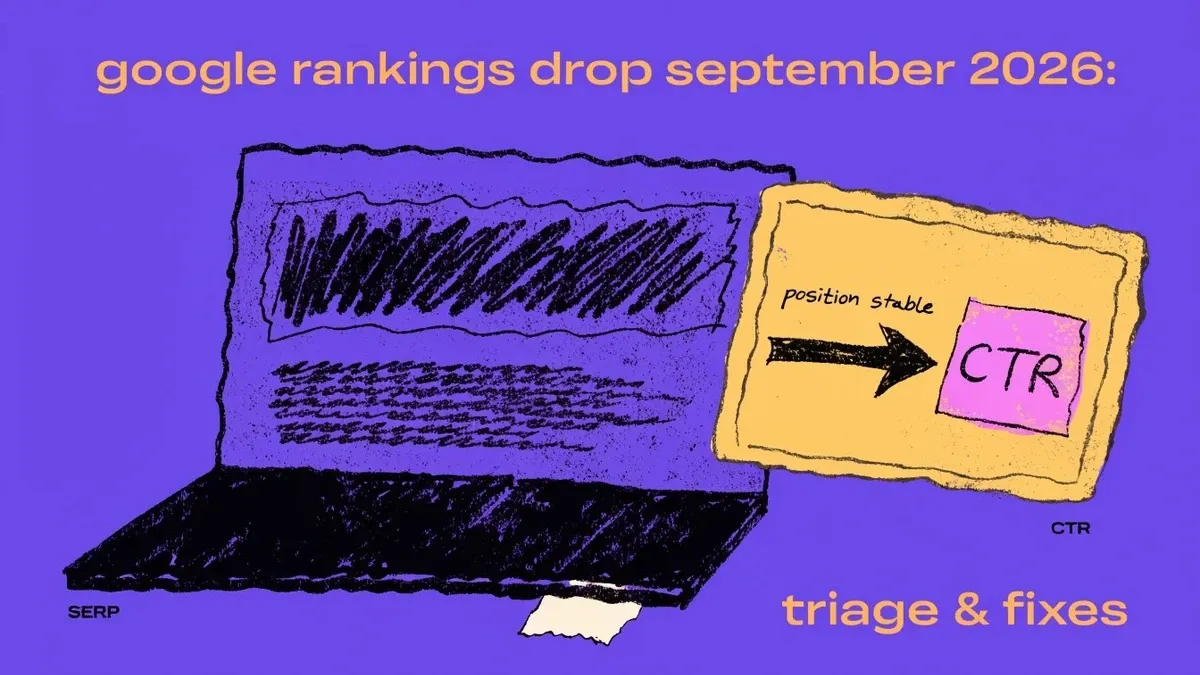
- Prove AI search displacement separately from blue-link ranking lossIf clicks fell while positions held, you’re losing SERP real estate to AI answers, not rankings.
- Template pages got hit hardestThin, near-duplicate city/service or SKU variants are fragile. Consolidate and add real information gain.
Why this video was worth covering
Sasha’s prompt matches reality: rankings moved, explanations didn’t. I’m using his question as the frame to share the triage I actually run with clients. No drama, just a sequence that forces evidence over vibes.
What changed from August to September
- The August 2026 spam update ran August 18–21, 2026 per Google’s Search Status Dashboard. Google described it as enforcing existing spam policies (no new policy announced). Those policies include scaled content abuse, doorway abuse, site reputation abuse, and more. Search Status Dashboard (status.search.google.com) · Spam policies (developers.google.com) · Coverage: Search Engine Journal (searchenginejournal.com), Search Engine Land (searchengineland.com).
- AI surfaces (AI Overviews/AI Mode) are absorbing clicks. In SISTRIX’s German dataset, position‑1 CTR drops from 27% to 11% when an AI Overview appears. Independent academic work estimates a −39.8% reduction in organic clicks when an AIO is present (conditional on appearance). SISTRIX report (sistrix.de) · SSRN field experiment (papers.ssrn.com). See also SEJ’s summary of the SISTRIX findings. SEJ (searchenginejournal.com).
- Ads/SERP UX shifted in 2026. Google is testing and rolling out new AI‑built ad experiences in Search (including AI Mode formats), updated “Sponsored results” labeling, and AI disclosure labels - all of which compress above‑the‑fold on many queries. Google Ads: new AI Search ad formats (blog.google) · Sponsored results label (blog.google) · AI transparency labels for ads (blog.google).
If you need a primer on AI cannibalizing clicks and how to measure it, read AI Search Traffic Loss: How to Prove Displacement and Rebuild Clicks. Pair that with the August checkup I actually run: August 2026 Spam Update Checkup.
The triage flow I actually run
Order matters. Don’t skip steps.
1) Confirm scope and timing
- Break out by query theme (brand vs non‑brand), page type, device, and country. One clean annotated timeline beats 20 guesses. 🔎
- If brand fell, that’s not an algorithm problem first, it’s demand or SERP presentation.
2) Separate ranking loss from click loss
- Pull positions and CTR together in GSC. If positions are steady but clicks sank, that’s often AI/ads/UX displacement. If positions cratered, that’s ranking.
- Build the GA4 proxy if you haven’t yet: Track AI Search in GA4 — How to Build a Defensible Proxy. It’s not perfect, but it’s the least‑bad lens we have 🧪.
- Cross‑check dates against Google’s guidance on diagnosing drops so you don’t mislabel visibility loss as rankings loss. Troubleshoot traffic drops (support.google.com).
3) Template inventory
- List every template cluster: /city/service, faceted categories, SKU variants, programmatic listicles. Measure duplication, thinness, cannibalization. 🧩
- If you run scaled pages with near‑zero information gain, flag them. This is where the August spam update pinched hardest - via policies like scaled content abuse and doorway‑like patterns. Spam policies (developers.google.com).
4) Page‑level quality signals
- For hit pages, compare pre/post update: content delta, unique entities covered, citing primary sources, original visuals/data. If nothing changed, why should you rank?
- Check outbound and inbound citations. Are you quote‑ready? Are others citing you? If not, fix that first. Related playbook: SEO Ranking Factors Now: Prioritize Info Gain & Citation‑Ready Pages (/blog/seo-ranking-factors-info-gain).
5) Technical sanity checks
- Indexing drift, canonical mismatches, pagination traps, noindex leaks. Boring, essential. 🧰
- Server logs: crawl budget shifts, unexpected 404/5xx spikes.
6) SERP reality check
- Pull live SERPs for 20 representative queries. Note AI answer presence, source domains, and where your actual pixel slot is. Screenshot now, not later.
- Tie this back to “positions stable, CTR down” vs “positions down across a cluster.” For CTR effects with AIOs, see SISTRIX’s aggregate numbers. SISTRIX (sistrix.de).
Quick hit fixes by bucket
| Symptom | Likely cause | First move |
|---|---|---|
| Positions down across a template cluster | Spam update pressure on thin or duplicate patterns | Consolidate variants, add real information gain, remove junk paths |
| Positions flat, clicks down | AI or ads displacement | Build AI or ads impact proof; re-target intent with formats AI cites (data, how-tos, comparisons) and add citations 🧠 |
| Brand down, everything down | Demand or PR issue | Repair brand SERP, refresh site links, update GBP; run PR, not just SEO |
How to fix template fragility (without burning it all down)
- Consolidate and canonically merge near‑duplicates. One authoritative page beats 12 near‑empty clones.
- Add unique, verifiable info: localized pricing bands, regulations, vendor lists, process photos, failure modes, warranty terms. Not fluff. Things only you can credibly publish.
- Add the right structured data and test it. Here’s how I evaluate whether schema helps AI surfaces and how to measure it: Does Schema Markup Help AI Search? Practical Proof and Metrics.
- Cite sources you’re comfortable being judged on. Citation‑ready content wins - for both Google and AI answers.
Proving and recapturing AI displacement
- Audit the AI answer: which entities and sources are being cited? If you’re absent, you’re not providing the right evidence.
- Add summary boxes, step flows, and tabular comparisons that can be excerpted. Precision beats prose here.
- Track with an AI visibility proxy and annotate releases; pair GA4 proxy signals with SERP screenshots so you can show stakeholders real movement over time 📊. For method and counter‑metrics, see Google AI Reports: Measure Displacement Before You Change Pages (/blog/measure-ai-displacement-reviews-links) and AI Search Traffic Loss: How to Prove Displacement and Rebuild Clicks. For macro CTR shifts, the SISTRIX and SSRN studies quantify the direction and scale. SISTRIX (sistrix.de) · SSRN (papers.ssrn.com).
Local businesses: a special note
- City/service templates are the classic weak point. If your “plumber in {city}” pages are 90% identical, expect volatility.
- Strengthen Google Business Profile, reviews with photos, and service area details that reflect reality. Then pipe those specifics into the page. It should feel unmistakably local, not mail‑merged 📍.
- Want a field‑tested pattern for home services? I wrote it up here: Dominate AI Search Results for Home Services (/blog/dominate-ai-search-home-services).
Priorities that move the needle
Stop the bleeding
- cut junk templates
- fix indexing leaks
- annotate AI displacement
Build the moat
- - build citation-ready, info-dense pages
- - add structured data and original media
- - earn references from credible sites
What I’m doing this week for clients
- Segment loss by bucket (spam vs AI vs template). No comms until this is clear.
- Ship one high‑signal rewrite in each hit cluster to test lift within 7–10 days.
- Stand up the GA4 AI proxy and screenshot SERPs for the evidence file. Yes, screenshots matter.
Don’t refactor your whole site based on a week of pain. Prove the cause, fix one cluster well, measure, then scale. That sequence saves budgets and rankings.
How do I know it’s the spam update and not AI answers?
If positions fell materially (for example, 4 to 14) across a template cluster in the Aug 18–21 window, treat it as content pattern risk. If positions held but clicks dropped, attribute it to SERP real estate (AI or ads). Many sites have both — separate them.
How fast can we see recovery?
Technical fixes can move in days; content pattern shifts take weeks. I aim for first signal within two weeks on a pilot cluster, then scale.
Should we nuke underperforming template pages?
Not blindly. Consolidate with intent — preserve equity, redirect smartly, and replace with a page that actually says something new.
Takeaway
September’s “rankings drop” isn’t one thing. It’s a mix of spam‑update pressure on thin templates, AI surfaces siphoning clicks, and a few technical drags you should rule out fast. Do it in order: verify dates against the official incident status.search.google.com, split ranking loss from click loss with GSC, audit template clusters for scaled‑content and doorway risk, and document live SERPs. Fix one cluster deeply, prove lift, then scale 🛠️. That’s how you protect classic SEO and the AI surfaces now competing for your users. (status.search.google.com)
